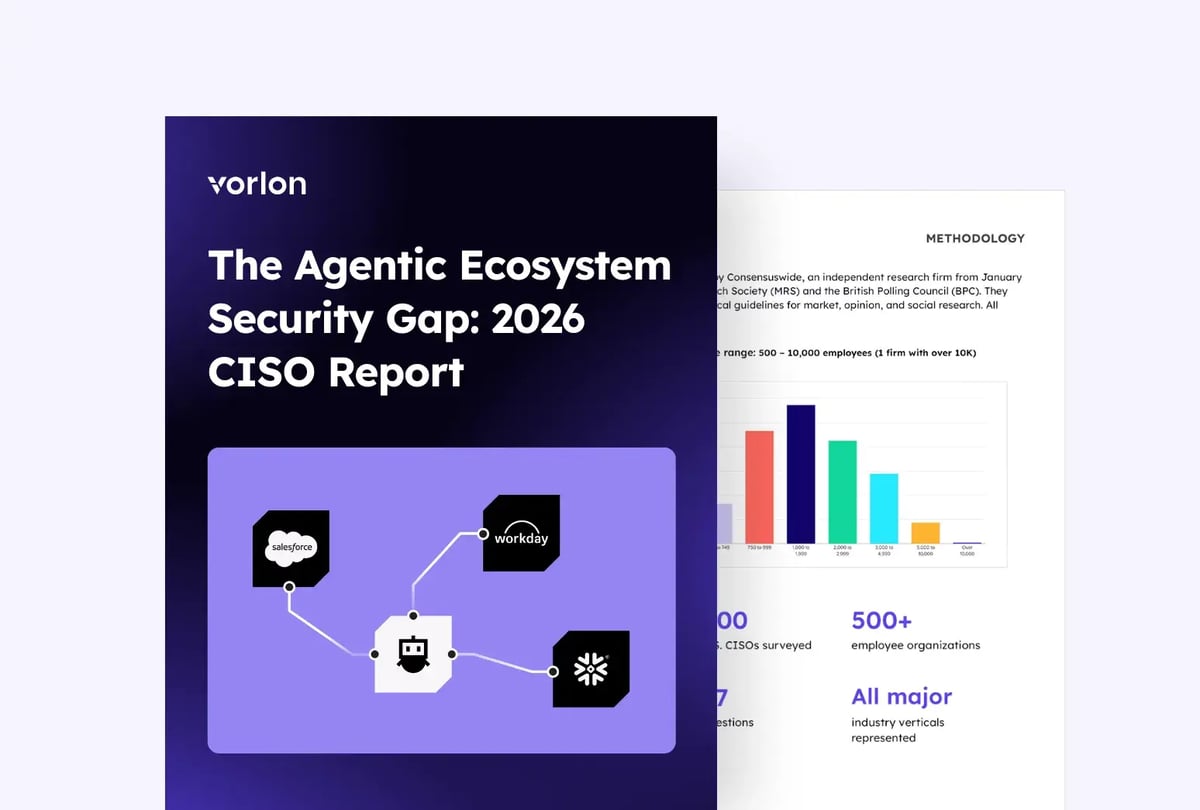
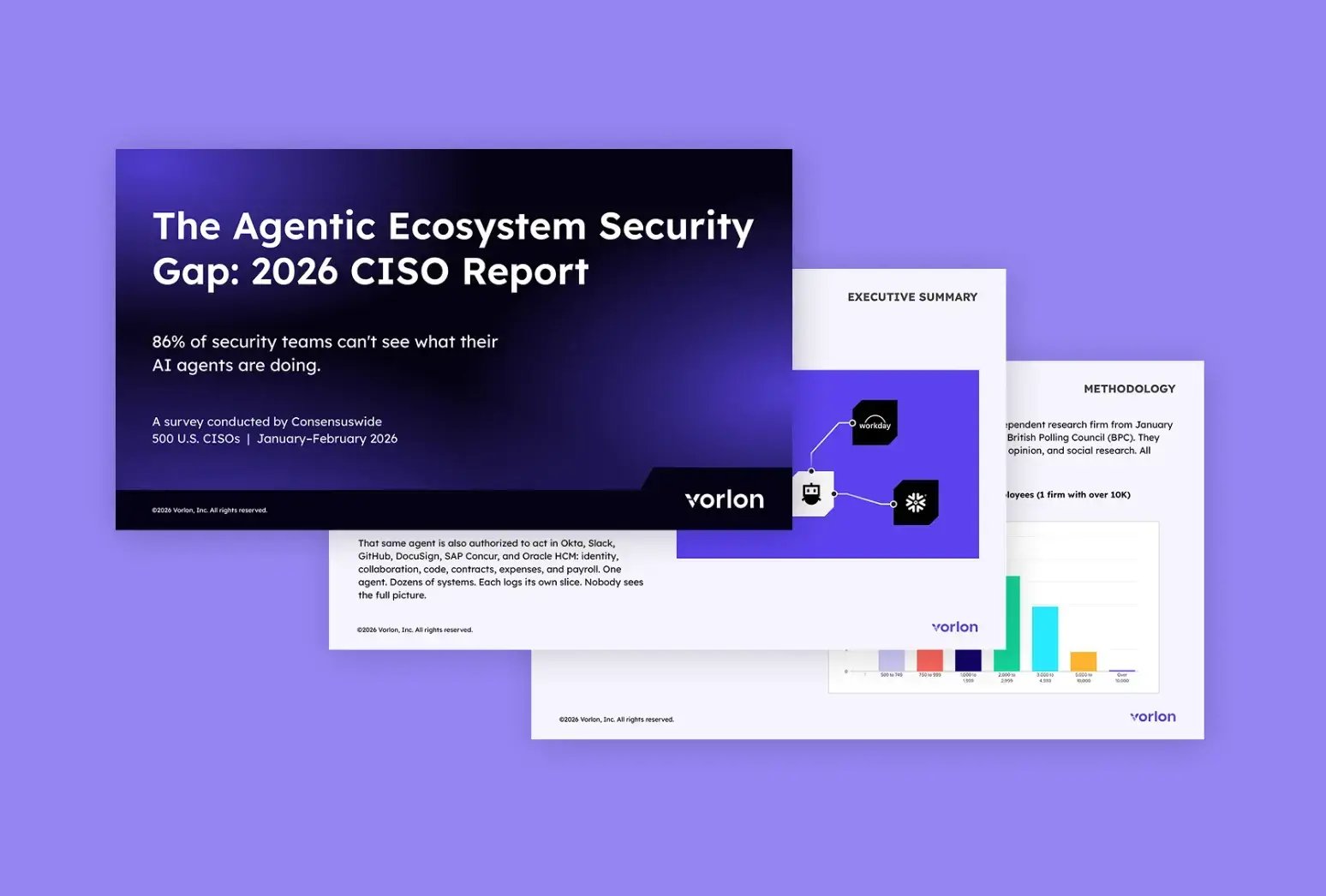
I want to tell you something that the data in our The Agentic Ecosystem Security Gap: 2026 CISO Report makes very difficult to argue with.
The enterprise security industry has spent the last decade building an increasingly sophisticated set of tools to govern access, audit configurations, and detect anomalous behavior. We have SSPM platforms, CASBs, ITDR tools, identity governance systems, and a growing category of AI-native security products. The average CISO in this survey is running 13.1 security tools across SaaS and AI security combined. We have invested enormously, as an industry, in getting better at security.
And 30.4% of the CISOs we surveyed experienced suspicious activity involving AI agents in 2025. 30.8% experienced unauthorized data exfiltration through SaaS-to-AI integrations. 27.4% experienced compromised OAuth tokens or API keys. 28.9% experienced a supply chain attack via a SaaS vendor.
These are not the numbers of an industry that has solved its security problem. They are the numbers of an industry that is solving the wrong one.
The threat has moved. The architecture has not kept up. That is the finding of this report, and I want to spend some time on it because understanding why is the first step toward changing it.
What we built, and why it made sense
The dominant security architecture of the past decade was built for a world where humans were the primary actors in enterprise systems. Users logged in. Users moved data. Users made mistakes or were socially engineered into them. The threat model was centered on the human layer: protect credentials, audit permissions, detect anomalous user behavior, configure applications correctly.
The tools built on that model are genuinely good at what they were designed to do. SSPM platforms give you a detailed picture of your SaaS application configurations. CASBs enforce policy at the access point. Identity threat detection tools look for anomalous patterns in how users authenticate and move through systems. These are well-engineered products, and the teams that built them are talented.
They were built for the front door.
The front door is where users log in, where permissions are set, where configurations are audited. It is the right place to look for the threats of five years ago. It is not where the most consequential threats live today.
The most consequential threats today live in the engine room — the runtime layer where AI agents operate autonomously, where OAuth tokens carry persistent cross-platform authorization, where custom SaaS-to-SaaS integrations move sensitive data between applications at machine speed, where non-human identities outnumber human ones by a ratio that grows every quarter. None of this looks like a login event. None of it triggers a configuration alert. Most of the tools we have built for enterprise security were not designed to see it.
That is the architectural gap. And the 2026 CISO Report is, as far as I know, the first dataset that measures it directly, at scale, across 500 CISOs.
What the data actually shows
We surveyed 500 U.S. CISOs in January and February of 2026. We asked them about incidents they experienced in 2025, their current security capabilities across 11 specific dimensions, their confidence in understanding which data their AI tools can access, their investment plans, and where they perceive the greatest risk.
The pattern that emerges is consistent across every industry sector, every company size, and every capability area we examined.
The tool coverage illusion
We asked CISOs to assess their current security tools across 11 specific capabilities relevant to securing the agentic ecosystem, which is the convergence of SaaS applications, AI agents, API integrations, non-human identities, and the sensitive data flows connecting them. Across the full survey population, every factor was rated as having limitations by 83–87% of organizations. This is not a tail risk. It is the norm.
The perception-capability gap
31.4% of CISOs characterize AI agents as a critical security risk. But awareness and capability are different things. Only 34.4% claim comprehensive real-time OAuth token governance. Only 38.2% claim comprehensive incident response coverage for their SaaS and AI ecosystem. Only 44% claim comprehensive threat hunting and investigation coverage. You can be fully aware that AI agents represent your biggest attack surface and still be running a security stack that cannot see into that surface in any meaningful way.
The incident rate
30.4% of CISOs reported suspicious activity involving AI agents in 2025. Nearly one in three security leaders at U.S. enterprises experienced a confirmed or suspected incident involving an AI agent last year. 28.9% experienced a SaaS supply chain attack. 27.4% had OAuth tokens or API keys compromised. These are not theoretical risks. They are current, active attack patterns.
The OAuth blind spot
OAuth tokens are how AI agents move through enterprise systems. Only 34.4% of CISOs have comprehensive real-time governance. The rest are flying partially blind through the credential layer that matters most.
The AI tool visibility gap
We asked CISOs about their confidence in understanding which data each of the major AI platforms can access in their environment. For Microsoft Copilot, 83.2% of CISOs report confidence — meaning nearly one in five lack confidence in what data a tool they deliberately deployed can access. For ChatGPT, 82.4%. For Gemini, 84.8%. But when you move beyond the big names, such as "other AI tools," overall confidence drops to 65.4%.
Why the sectors that are most alert are still getting hit
One of the more counterintuitive findings is the relationship between security investment, risk awareness, and incident rates in the sectors doing the most.
The financial services sector is the most security-invested sector in our survey. CISOs there run an average of 15.6 security tools across SaaS and AI security combined — about 20% above the cross-industry average. 45.3% characterize AI agents as a critical security risk, the highest of any sector. And they are getting hit at above-average rates: 37.7% experienced a supply chain attack via SaaS vendors, 26% above the cross-industry rate.
Investment is not the problem. Awareness is not the problem. Architecture is the problem.
The insurance industry tells a different version of the same story. Only 17.7% of insurance CISOs call AI agents a critical risk, compared to 45.3% in financial services — a gap of 27 percentage points between sectors with substantially similar regulatory exposure. The explanation I find most credible in the data is not that insurance organizations face genuinely lower AI risk. It is that insurance CISOs have lower visibility into their AI agent ecosystem than in any other sector, and lower visibility leads to lower measured concern.
Then there's the healthcare industry. Which has the highest breach costs of any industry ($10.9M average, more than double the cross-industry average), the highest AI agent incident rate, the lowest AI tool visibility, and the most conservative security investment trajectory of any sector. The sector with the most to lose is moving the most slowly to close the gap.
The compliance dimension
This would be a significant security problem even if regulators were not paying attention. They are.
The SEC's cybersecurity disclosure rules require public companies to disclose material incidents within four business days and to describe their third-party risk management processes in annual filings. FFIEC guidance sets baseline expectations for U.S. banks and credit unions.
The updated HIPAA Security Rule explicitly requires healthcare organizations to maintain AI tool inventories, monitor SaaS data flows, and maintain audit logs sufficient to support breach investigation.
NAIC's Insurance Data Security Model Law is being updated to address AI governance in 24 states. For organizations with EU operations, DORA has been in effect since January 2025.
Regulators across financial services, insurance, and healthcare are asking the same question: Do you know what your AI tools are doing with sensitive data, and can you prove it? The survey data suggests most enterprises cannot answer that question to the standard regulators are now setting.
What the architecture actually needs to change
The fundamental shift required is from configuration auditing to runtime monitoring. The security question is no longer only 'what does the configuration allow?' It is 'what is actually happening?' Those are different questions, and they require different tools.
Runtime monitoring of the agentic ecosystem means being able to see, in near real time:
- Which AI agents are active and what SaaS systems they have access to
- Which OAuth tokens are live, what scope they carry, and whether they are being used consistently with their intended purpose
- What data is moving between which systems through which integrations
- Whether non-human identity behavior is consistent with baseline
- When something anomalous happens, what the full chain of events looks like across every connected system
The second shift is extending incident response to cover the agentic ecosystem specifically. When a supply chain attack executes through a SaaS integration, the blast radius extends across every system that the OAuth token was authorized to access. IR playbooks for endpoint and network incidents need to be updated to reflect this reality.
The third shift is closing the ownership gap. For example, when there's a breach in a SaaS application, there is no industry consensus on who owns the impact assessment. Responses span nine organizational functions, with no single team cited by more than 21.8%.
What we built vorlon to do
I want to be transparent about something. We built Vorlon because we saw this problem coming and couldn't find a tool that addressed it.
The existing security platforms are excellent at what they were built for. We did not build Vorlon to compete with them. We built it to see what they cannot see which is the runtime layer of the agentic ecosystem, where AI agents operate, where OAuth tokens carry authorization, where sensitive data moves between systems at machine speed, where non-human identities now outnumber human ones in most large enterprises.
Vorlon's DataMatrix™ technology builds a live, continuously updated model of how sensitive data, identities, and integrations interact across an organization's agentic ecosystem. It tracks OAuth token activity, non-human identity behavior, and cross-platform data movement in near real time. When something goes wrong, it can reconstruct exactly what happened — which data, which systems, which agents, in what sequence — in a form that supports both internal investigation, remediation, and regulatory disclosure.
The bottom line
The 2026 CISO Report is not a comfortable read. 30% of CISOs experienced a supply chain attack last year. 30.4% experienced a security incident involving an AI agent. The vast majority report limitations in their current tools across every capability required to secure the agentic ecosystem.
The agentic ecosystem is the primary attack surface of the enterprise in 2026. The tools most organizations run were built for a different era. The regulatory frameworks governing financial services, insurance, and healthcare are now specifically asking whether organizations can demonstrate what their AI tools did with sensitive data.
The answer most organizations can currently give is inadequate. Changing that requires different architecture, not just more of the same.
→ Read the full 2026 CISO Report
About Vorlon
Vorlon is the Agentic Ecosystem Security Platform. Vorlon's patented DataMatrix™ technology builds a live model of how sensitive data, identities, and integrations interact across your SaaS and AI ecosystem, giving security teams the runtime visibility, OAuth governance, and forensic audit trail capabilities needed to detect threats, assess blast radius, remediate incidents, and reconstruct exactly what happened across every connected system.
Frequently asked questions
What is the agentic ecosystem and why is it a security risk?
The agentic ecosystem refers to the network of AI agents, SaaS applications, third-party integrations, OAuth tokens, API connections, and non-human identities that collectively handle an enterprise's sensitive data and execute its workflows. It is a security risk because it operates at a layer that most existing security tools were not designed to monitor. AI agents access SaaS systems autonomously via OAuth tokens, move data between platforms at machine speed, and operate without triggering the login events and configuration alerts that traditional security monitoring is built around.
What is the difference between agentic ecosystem security and traditional SaaS security?
Traditional SaaS security tools — including SSPM platforms and CASBs — are primarily configuration-focused and point-in-time. They tell you what permissions exist, what configurations are set, and what policies are being violated. Agentic ecosystem security is runtime-focused. It monitors what AI agents, integrations, and non-human identities are actually doing with their access — what data is moving, between which systems, through which credentials, and whether that behavior is consistent with its intended scope.
What are the most common AI agent security incidents affecting enterprises in 2025?
According to the 2026 CISO Report, the most commonly reported incidents were: suspicious or anomalous activity involving AI agents (30.4% of CISOs); unauthorized data exfiltration through SaaS-to-AI integrations (30.8%); supply chain attacks via SaaS vendors (28.9%); compromised OAuth tokens or API keys (27.4%); and social engineering attacks targeting SaaS credentials (33.6%).
What is OAuth token governance and why does it matter for enterprise AI security?
OAuth tokens are the authorization credentials through which AI agents access SaaS systems. Unlike passwords, they grant persistent, often broadly scoped access that does not require re-authentication. Comprehensive real-time OAuth governance means knowing which tokens are active, what scope they carry, what systems they are authorized to access, and whether they are being used consistently with their intended purpose. The 2026 CISO Report found that only 34.4% of CISOs claim comprehensive real-time OAuth governance.
What should CISOs do first to address the agentic ecosystem security gap?
The 2026 CISO Report data points to four high-priority starting points. First, conduct a complete inventory of AI agents and SaaS integrations currently active in your environment. Second, assess your OAuth token governance. Third, evaluate your incident response coverage specifically for agentic ecosystem incidents. Fourth, map your current tool coverage against the 11 capability dimensions in the report to identify where your gaps are largest relative to the threat surface you actually face.
How are enterprise security regulators approaching AI agent and SaaS security in 2026?
Regulatory frameworks across major sectors are converging on a common expectation: enterprises must be able to demonstrate what their AI tools and SaaS integrations are doing with sensitive data, and must be able to reconstruct what happened in the event of an incident. The SEC, FFIEC, updated HIPAA Security Rule, NAIC model law update, and DORA all point in the same direction. The era of 'we have a security program' as a sufficient answer is ending.
What is a non-human identity and why does it create security risk?
A non-human identity (NHI) is any software entity — an AI agent, an automated workflow, a service account, a bot, an API integration — that authenticates to enterprise systems independently of a human user. Non-human identities now outnumber human identities in most large enterprise environments and are growing faster. They create security risk because they operate continuously, often with broad permissions, without the behavioral patterns that human activity creates, and frequently across multiple connected systems simultaneously.
All data: The Agentic Ecosystem Security Gap: 2026 CISO Report. Conducted by Consensuswide, January 27 – February 9, 2026. n=500 U.S. CISOs. Vertical subsets: n=106 Financial Services U.S. CISOs; n=62 Insurance U.S. CISOs; n=52 Healthcare and Life Sciences U.S. CISOs.


.png?width=329&height=222&name=blog%20451%20why%20saas%20and%20ai%20are%20converged%20(1).png)