.png?width=1200&height=820&name=blog%20launch%20AI%20agent%20action%20center%20and%20flight%20recorder%20(1).png)
When I joined Vorlon three years ago, the conversation about AI agents in the enterprise was mostly theoretical. Security leaders knew AI was coming. They knew it would create new risks. But the shape of those risks, what they'd actually look like at 2 am when something went wrong, was still fuzzy.
It isn't fuzzy anymore.
Over the past year, I've had dozens of conversations with CISOs and security leaders, and the story has shifted completely. What I kept hearing wasn't "we're worried about AI agents." It was "something already happened, and we couldn't tell what." An anomalous alert. A data access pattern that didn't look right. An OAuth token that showed up somewhere it shouldn't have. And almost every time, the same follow-up: we spent days trying to piece together what the agent actually did, and we still couldn't get the full picture.
That gap, between something happened and here's exactly what happened, is what we've spent the last year building for. Today, at RSA 2026, we're closing it.
We're launching two new products: the Vorlon AI Agent Flight Recorder and the Vorlon AI Agent Action Center. Together, they take Vorlon from detection to resolution, giving security teams a complete forensic record of every AI agent action and a coordinated path to fix what's wrong.
The problem we were solving
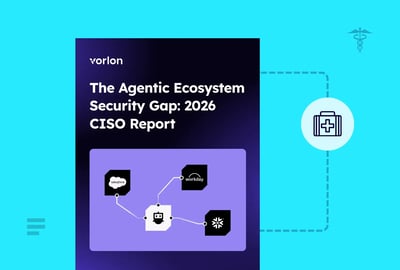
The agentic ecosystem is the converged layer of SaaS applications, AI agents, API integrations, and non-human identities. It's now the fastest-growing attack surface in the enterprise. Our own survey of 500 U.S. CISOs found that 99.4% experienced at least one SaaS or AI ecosystem security incident in 2025. [Read the full report →]
The tools most security teams have weren't built for this. They were built to monitor the front door: application configurations, permission settings, login events. Human-speed, application-by-application.
AI agents don't use the front door. They operate in the engine room, through APIs, across multiple SaaS systems simultaneously, with OAuth tokens that persist long after the original authorization event. A single agent can touch five systems, move PII and financial records, and trigger downstream workflows in under 30 seconds. Most of that activity was, until now, invisible.
86.8% of the security leaders in our survey said their tools can't see what data AI tools are exchanging with SaaS applications. That isn't a gap in one tool. It's a structural characteristic of an entire generation of security architecture that wasn't designed for a world where the workforce includes machines.
What those CISOs kept telling me was some version of the same thing: "We know something is wrong. We just can't prove it fast enough to do anything about it."
That's what we built for.
See it in action
Before I walk through each product, here's what the Flight Recorder and Action Center look like working together: detection and response as a single motion.
In this demo, we walk through a real-world scenario where a Copilot agent silently downloaded a signed document from DocuSign, created a public folder in Box, and uploaded the file, exposing sensitive contractual data to anyone with the link. Vorlon's Action Center flagged the anomaly instantly, and using the Flight Recorder, we were able to stitch together the agent's full activity across DocuSign and Box into a single, coherent conversation, turning what could have been a days-long investigation into a resolution in minutes.
AI Agent Flight Recorder: The record that didn't exist
The mental model behind the Flight Recorder came directly from those customer conversations. One CISO put it plainly: "When a plane crashes, there's a flight recorder. When one of our AI agents does something it shouldn't, we have nothing."
That's what we built. An immutable, query-able, forensically complete audit trail of every AI agent action across your entire agentic ecosystem. Not within one application. Across every SaaS app, every API endpoint, every integration the agent touches.
Here's what it captures:
A cross-system behavioral baseline. Before you can detect an anomaly, you need to know what normal looks like, not for one application in isolation, but across every system the agent operates in. The Flight Recorder continuously builds that baseline. When an agent's behavior shifts, Vorlon sees it: different data types, unusual volumes, new destinations, off-hours activity.
Sensitive data classification at the agent level. Every agent action is mapped to what data it touched: PII, PHI, PCI, credentials, intellectual property. Vorlon's API endpoint analysis does this without content inspection, classifying data at the structural level, privacy-preserving by design. For the first time, a security team can say with precision: "This agent accessed customer records containing Social Security numbers and credit card data across these three systems. Here's the timestamp, the identity, every step."
Blast radius in minutes, not days. When something goes wrong, the immediate question is how far the damage spread. The Flight Recorder calculates blast radius in near real-time: which sensitive data categories were accessible, which integration paths were involved, and which downstream systems are at risk. The answer a board needs at 9 am is ready before the morning standup.
An immutable audit trail. Every action. Every identity. Every endpoint. Every timestamp. Queryable. Available in minutes. Designed to meet the evidentiary requirements of SOC 2, HIPAA, PCI DSS, GDPR, ISO 27001, NIS2, DORA, and the EU AI Act.
The Flight Recorder is built on DataMatrix™, Vorlon's patented intelligent simulation technology. DataMatrix ingests telemetry from SaaS and AI tools, API and MCP communications, and human and non-human identities, transforming fragmented data into a live model of how your agentic ecosystem actually behaves. That's what makes a true cross-platform record possible, where every other approach falls short.
AI Agent Action Center: From finding to fix
Detection is necessary. It is not sufficient.
What I heard from security teams over and over was a version of this: "We get the alert. And then we spend the next four hours figuring out who should handle it, what they should do, and whether it actually got done." The alert lands in a queue. The queue belongs to SecOps. But the fix requires an app owner, an IT admin, or a compliance officer, someone who isn't watching the SecOps queue and doesn't know what "remediate this finding" means for their system.
The Action Center is where that problem gets solved.
Once a finding surfaces, from the Flight Recorder, from Vorlon's detection engine, or from an integrated security tool, the Action Center prioritizes it, routes it to the right person or system, provides step-by-step remediation guidance in plain language, and tracks every ticket through to resolution. It connects to the tools your teams already use: SIEM, SOAR, ITSM, identity providers, threat intelligence feeds.
The findings fall into three categories. This taxonomy came directly from what customers told us they needed.
Universal findings are things that should never happen regardless of environment. An AI agent provisioned with full admin-level permissions to sensitive customer records, far beyond what its function requires. No contextual judgment needed. Fix it.
Behavioral findings are anomalies tied to your specific agent usage and traffic patterns. A new MCP server connecting an existing agent to an application holding sensitive data. An agent querying financial records at 3 am at ten times its baseline volume. These are the findings that require the Flight Recorder's behavioral baseline to surface, and the Action Center to route to the right owner.
Dynamic findings are custom rules your security team writes to close the gaps AI vendors leave open. Not all versions of OpenAI and Claude support IP-based access restrictions, which means if a compromised agent credential gets used from an unauthorized location, most platforms can't stop it. Vorlon lets you enforce that boundary without waiting on a vendor release cycle. You write the rule. Vorlon helps you enforce it.
The scenario above brings this to life. Microsoft Copilot agent quietly downloads a signed document from DocuSign, creates a public folder in Box, and uploads the file — exposing sensitive contractual data outside any approved workflow. Behind the scenes, Vorlon’s AI Agent Flight Recorder stitches the agent's activity across both applications into a single coherent timeline, so nothing gets lost between tools. The Action Center surfaces the anomaly, routes it to the right owner, and makes remediation straightforward. What would have taken days to reconstruct and hours to coordinate is resolved in minutes, with a documented, auditable record of every action taken.
Each stakeholder, CISO, application owner, and compliance officer, sees the findings and workflows relevant to their role. No more all-hands alerts. No more findings that fall through the cracks because they landed in the wrong queue.
Why these two products belong together
The Flight Recorder and the Action Center are not two separate products. They are two halves of the same motion. Detection without response is frustration. Response without forensics is guesswork. You need the complete record of what happened and a coordinated path to fix it.
According to Gartner®, "Enabling effective incident response is often the last step when implementing an agentic AI cybersecurity program, which puts it at risk of negligence from key stakeholders, or delayed implementation."2 That's exactly what the Action Center is designed to prevent.
Security teams have built mature response workflows for endpoints and infrastructure over many years. The agentic ecosystem deserves the same standard. The Flight Recorder and Action Center bring it.
Try it
If you're at RSA, come find us at Booth NXT-07, Early Stage Expo South, Level 2. We're running live demos all week.
If you'd rather connect one-on-one, reach out to me directly, book a demo, or contact our team. I find the most useful conversations are the ones where a security leader brings their specific environment and we work through what the Flight Recorder and Action Center would actually show them.
The agentic workforce is already running in your environment. Let's make sure it doesn't run in the dark.
— Netta Drimer, Head of Product, Vorlon
Sources:
-
The Agentic Ecosystem Security Gap: 2026 CISO Report, Vorlon, March 2026.
-
Gartner®, How to Secure Enterprise Agentic AI Ambition, Jeremy D'Hoinne, Dionisio Zumerle, January 5, 2026. GARTNER is a registered trademark and service mark of Gartner, Inc. and/or its affiliates in the U.S. and internationally and is used herein with permission. All rights reserved.