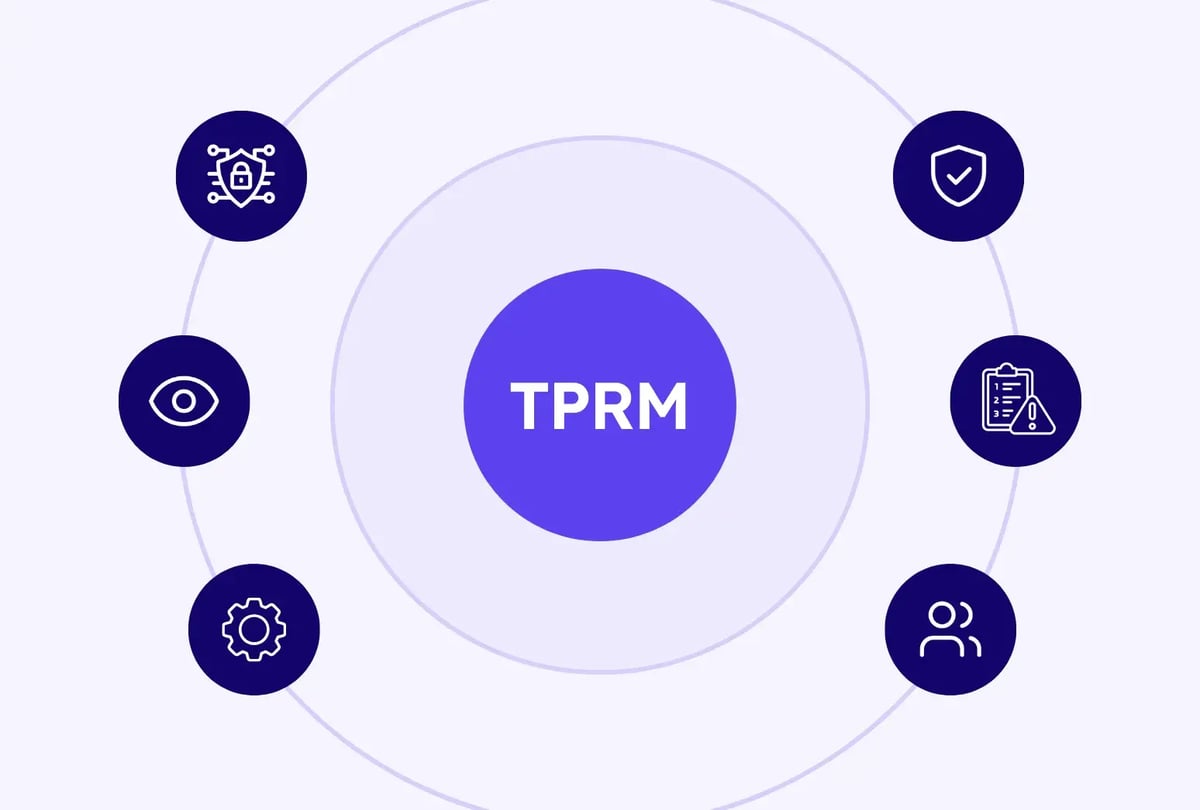
Third-Party Risk Management (TPRM) is the discipline of protecting your organization from the risks that come with vendors, suppliers, partners, and service providers. Every external connection, whether it’s a cloud platform, a contractor, or a critical supplier, creates potential exposure to cyber threats, compliance failures, financial liability, or reputational damage.
A strong TPRM program serves as your outer perimeter defense, providing visibility and control to manage risks to your organization.
What is third-party risk management (TPRM)?
Third-Party Risk Management is how an organization identifies, assesses, and reduces the risks associated with vendors, suppliers, service providers, and other external partners, including SaaS and cloud providers. It spans the full vendor lifecycle and even extends to “fourth parties,” such as your vendors’ vendors, ensuring risks are tracked wherever they originate.
Think of it as your outer perimeter defense system, protecting not just your own operations but the wider network you rely on.
Why does TPRM matter?
TPRM is your company’s frontline defense against external risk. Without it, hidden threats can catch the business off guard and cause serious damage.
Effective TPRM:
- Reduces security, privacy, operational, financial, and compliance risk introduced by third parties.
- Required or strongly expected by many regulators and customers.
- Enables secure and scalable use of external services (especially SaaS/cloud).
These same pressures drive organizations to adopt continuous oversight across their SaaS and AI ecosystems. This approach is outlined in Vorlon’s Unified SaaS and AI Security framework.
- 60% of data breaches in 2024 involved a vendor or supplier (Verizon DBIR).
- Average breach cost linked to third parties: $4.76 million (IBM Cost of a Data Breach Report).
- Large enterprises rely on 400+ vendors on average, each introducing new data pathways.
- Regulators now expect continuous monitoring, not annual assessments.
What counts as a third-party risk?
Third-party risk is any risk inherited by relying on another organization. If an outside partner can access your data, systems, finances, or reputation, they create risk you must manage.
Below are common categories with examples:
Security and Technical Risks
Weak security controls, over-privileged access, API or OAuth misuse, SaaS misconfigurations, software supply chain compromise, infected endpoints, or malicious insiders.
Privacy and Data Protection Risks
Unlawful processing or transfer, excessive data retention, missing data-subject rights handling, or unknown subprocessors.
Operational and Resilience Risks
Vendor downtime, single-provider dependence, capacity issues, change management failures.
Compliance and Legal Risks
Missing certifications (SOC 2, ISO 27001), breach-notification failures, IP or export-control violations.
Financial and Fraud Risks
Invoice fraud, hidden fees, vendor insolvency.
Strategic and Reputational Risks
Vendor lock-in, ownership changes, ESG controversies.
AI/ML-Specific Risks
Data used for model training, compromised inference APIs, unclear licensing, or provenance.
Fourth-Party and Dependency Risks
Hidden subcontractors, geopolitical exposure, or data residency changes.
To track and mitigate these risks across hundreds of connected services, organizations rely on continuous monitoring and contextual analytics, both built into the Vorlon Platform.
- Fragmented visibility across hundreds of SaaS and AI integrations.
- Hidden fourth-party dependencies that evade manual audits.
- Over-privileged tokens and service accounts.
- Unverified AI tools accessing sensitive data.
- Disconnected compliance reporting across vendors.
What are the main risks and threats in TPRM?
Third‑Party Risk Management (TPRM) helps identify and control the many ways vendors can introduce risk into your organization. The most common threats include:
- Cybersecurity risks: Weak vendor security controls can expose sensitive data, as seen in the 2025 Salesforce breach.
- Operational risks: Service delays or outages disrupt supply chains and customer commitments.
- Compliance risks: Vendors that mishandle regulated data can face fines under laws such as GDPR or HIPAA.
- Reputational risks: Unethical or non‑compliant partners can damage brand trust.
- Financial risks: Vendor insolvency or fraud directly impacts profitability.
- Strategic and concentration risks: Overreliance on a single provider limits flexibility and resilience.
- Legal and geopolitical risks: Contract breaches or instability in vendor regions can halt operations.
The impact of each risk depends on your vendor landscape and oversight maturity. According to GartnerⓇ “Expanded risk exposure has led to increased board and stakeholder oversight of third-party risk management (TPRM) programs.” A robust framework enables organizations to continuously evaluate and mitigate these risks, such as protecting security, compliance, and business confidence.
How SaaS ecosystems struggle with TPRM
SaaS ecosystems expand risk faster than traditional TPRM can track. Here’s where most programs struggle:
- Data access and control: SaaS vendors handle sensitive data and often use their own third parties, limiting visibility.
- Regulatory compliance: Providers operate under different laws, creating unseen compliance gaps.
- Vendor interdependencies: Fourth- and fifth-party risks are difficult to trace.
- Lack of oversight: Without continuous monitoring, vendor practices go unchecked.
- Rapid onboarding and offboarding: Apps are added or dropped before full risk evaluation.
- Manual risk assessments: Too many programs rely on slow, spreadsheet-based reviews.
Lack of oversight and rapid onboarding are exactly where Vorlon’s SaaS Ecosystem Visibility Layer delivers value, mapping data flows and permissions across every SaaS and AI integration.
Vorlon integrates with leading SIEM, SOAR, and ITSM tools like Splunk and ServiceNow to automate risk detection and response. See all supported integrations.
SaaS ecosystems multiply your vendor surface faster than traditional TPRM can track. Without continuous monitoring, risks spread through OAuth links, shadow AI tools, and unlogged data flows. Static questionnaires can’t protect what you can’t see in real time.
What does a TPRM program do?
A Third‑Party Risk Management (TPRM) program gives an organization a structured way to manage vendor risk from start to finish. It begins by identifying every external partner that connects to your systems or handles your data, then evaluating each one for security, compliance, financial, and operational stability.
Once risks are understood, the program defines how they’ll be managed—whether through stronger contracts, tighter controls, or alternative vendors. From there, continuous monitoring keeps watch for changes in performance or new threats, ensuring that safeguards remain effective as conditions evolve.
In essence, a TPRM program transforms vendor oversight from a periodic checklist into a living process that protects data, continuity, and reputation every day.
How does TPRM fit into a greater enterprise risk management (ERM) strategy?
TPRM is the external lens of Enterprise Risk Management (ERM). While ERM looks inward to identify strategic and operational threats, TPRM looks outward to track the risks that flow through vendors, suppliers, and partners.
By feeding real‑time intelligence about third‑party security, compliance, and performance into the broader ERM program, TPRM closes visibility gaps and strengthens decision‑making. Together, they create a unified, proactive approach to risk: ERM provides the strategy, and TPRM delivers the situational awareness needed to act on it.
This integration turns vendor oversight into a core component of enterprise resilience, ensuring that every partnership supports, not jeopardizes, security, compliance, and business continuity.
The Core Elements of TPRM
TPRM is an architecture structured to detect weakness, direct response, and sustain trust across your external ecosystem. Its essential elements are the following:
- Risk identification. Map all risks linked to vendors: cyber, compliance, financial, operational, or contractual.
- Risk assessment.Measure each risk with precision and accuracy. Define impact, likelihood, and disruption potential. Classify them, not by guesswork but by consequence.
- Risk prioritization.Not all risks carry equal weight. Elevate the critical, demote the trivial. This hierarchy determines where energy and resources should be allocated.
- Risk management.Act with intent. Shape controls, refine contracts, redesign processes, or sever relationships where required. Mitigation is the shift from knowledge to power.
- Continuous monitoring.Risk is alive. It changes with markets, technology, and geopolitics. Ongoing surveillance ensures threats are tracked before they evolve into breaches.
- Documentation and reporting. Evidence is essential. Record what is discovered, decided, and done. Share it with leadership, auditors, regulators—proof that vigilance is not assumed but demonstrated.
- Learning and improvement.A program that does not adapt will erode over time. Extract lessons from every incident, audit, and assessment. Turn data into intelligence and intelligence into evolution.
- Vendor management. Partnerships are not trusted by default. Inspect vendors’ controls, contracts, and performance. Monitor their financial health as much as their security posture.
- Incident response planning. Prepare for failure. When disruption strikes, speed and clarity matter. A practiced response limits damage and accelerates recovery.
- Compliance and regulations.Anchor your program in regulations and standards. Adherence protects not only from penalties, but from blind spots in governance.
- Training. Everyone is a potential guardian or gap. Equip your people with awareness of risks, processes, and expectations. Knowledge distributed strengthens resilience.
How do you set up a TPRM program?
A TPRM program is a living system designed to reveal and control the risks introduced through external partnerships.
Steps to build one:
- Develop a TPRM policy.Write the rules of engagement. Your TPRM policy should lay out how risks will be identified, measured, and managed. First, set the expectation: security requirements, compliance standards, and response protocols.
- Identify third parties. Inventory every vendor, partner, and supplier. Include those already embedded in your operations, as well as those under consideration. Visibility is the foundation of control.
- Classify by risk.Not all third parties carry equal weight. Prioritize them based on impact, considering the sensitivity of data, business criticality, geographic exposure, and overall access to your organization.
- Evaluate third parties.Conduct structured risk assessments. Examine security posture, compliance maturity, financial strength, and operational resilience. Identify weaknesses before they become failures.
- Implement risk controls. Where risk emerges, apply countermeasures. This can take the form of stronger contractual requirements, enhanced data protections, or multi-vendor contingency strategies.
- Monitor and audit. Risk evolves. Continuous monitoring keeps you aware of changes, while periodic audits confirm adherence to your standards. Without surveillance, controls decay.
- Train employees.Every employee is a potential link in the chain. Teach them to recognize third-party risks, because risk is never contained to one team.
- Automate with purpose.A TPRM platform accelerates intelligence gathering, assessments, and tracking at scale. Integrated tools transform risk management from a reactive effort into a systematic and disciplined approach.
- Review and update. Regularly review and update your TPRM program to ensure it stays relevant as the risk landscape changes.
- Continuously Improve: Utilize insights gained from monitoring and audits to enhance your TPRM program continually.
- Continuously audit vendor API activity and access scopes.
- Correlate vendor alerts with your SIEM for faster triage.
- Automate offboarding to revoke stale credentials immediately.
- Use risk scoring to prioritize vendor reviews.
- Monitor for new OAuth or AI tool connections daily.
Tools that help a TPRM program
A strong TPRM program is easier to run with the right tools. These platforms streamline risk assessments, automate monitoring, and provide the visibility needed to stay ahead of threats. Each supports a different layer of the TPRM process, from questionnaire-based due diligence to continuous ecosystem monitoring.
BitSight:
Provides external security ratings based on threat intelligence and internet‑facing data. Great for benchmarking a vendor’s cyber posture, but it doesn’t analyze internal configurations or SaaS data flows.
OneTrust:
Offers Vendorpedia, a questionnaire‑driven platform for vendor inventories, risk assessments, and compliance documentation. It centralizes due diligence but relies on self‑reported data from vendors.
RiskSense (now Ivanti):
Focuses on vulnerability management and remediation prioritization across IT assets. Strong for internal risk scoring, less suited for ongoing third‑party visibility.
LogicGate:
Delivers workflow automation for governance, risk, and compliance (GRC) processes. It’s a flexible framework but requires manual data inputs from other systems.
CyberGRX:
Provides standardized third‑party assessments and analytics to benchmark vendor risk. Efficient for scaling questionnaire reviews, but not a live monitoring solution.
Prevalent:
Automates vendor assessments, continuous monitoring, and threat intelligence feeds. It focuses on third‑party questionnaires and alerting but not on SaaS‑level data mapping.
RSA Archer:
A mature GRC platform covering governance, risk, and incident management. Highly configurable but complex to deploy and maintain.
UpGuard:
Combines external security ratings with automated risk assessments and vendor monitoring. Useful for surface‑level cyber posture tracking, less for identity or data‑flow context.
Expands TPRM into SaaS and AI ecosystems with continuous, in‑product monitoring. Vorlon maps vendor data flows, OAuth permissions, and non‑human identities in real time, providing context traditional TPRM tools can’t.
The right tool should fit your needs and extend your processes, not replace them. Traditional TPRM platforms manage documentation and due diligence; Vorlon complements them with live SaaS and AI ecosystem mapping for rapid detection and response.
How does Vorlon help enterprise SaaS with TPRM?
Vorlon transforms static vendor checks into living defense. Its continuous, in‑product monitoring expands your TPRM: watching SaaS, identities, OAuth links, data flows, and AI tools. Always on. Always aware.
Therefore, Vorlon gives enterprise SaaS teams the visibility and control to keep vendor risk in check. It automates assessments, tracks SaaS providers continuously, and maps fourth-party dependencies so nothing slips past the shield. Compliance stays aligned, reporting stays clear, and monitoring never stops. Instead of chasing vendors with manual work, enterprises get a single system that keeps their entire SaaS ecosystem secure, compliant, and mission-ready.
Think of it as the command console for your vendor fleet; a single system that keeps your SaaS ecosystem secure, compliant, and mission-ready. Explore the Vorlon Platform Overview or see how it applies to SaaS and AI ecosystems.
Third-Party Risk Management (TPRM): An Essential Guide. GARTNER is a registered trademark and service mark of Gartner, Inc. and/or its affiliates in the U.S. and internationally and is used herein with permission. All rights reserved.


.png?width=329&height=222&name=blog%20451%20why%20saas%20and%20ai%20are%20converged%20(1).png)