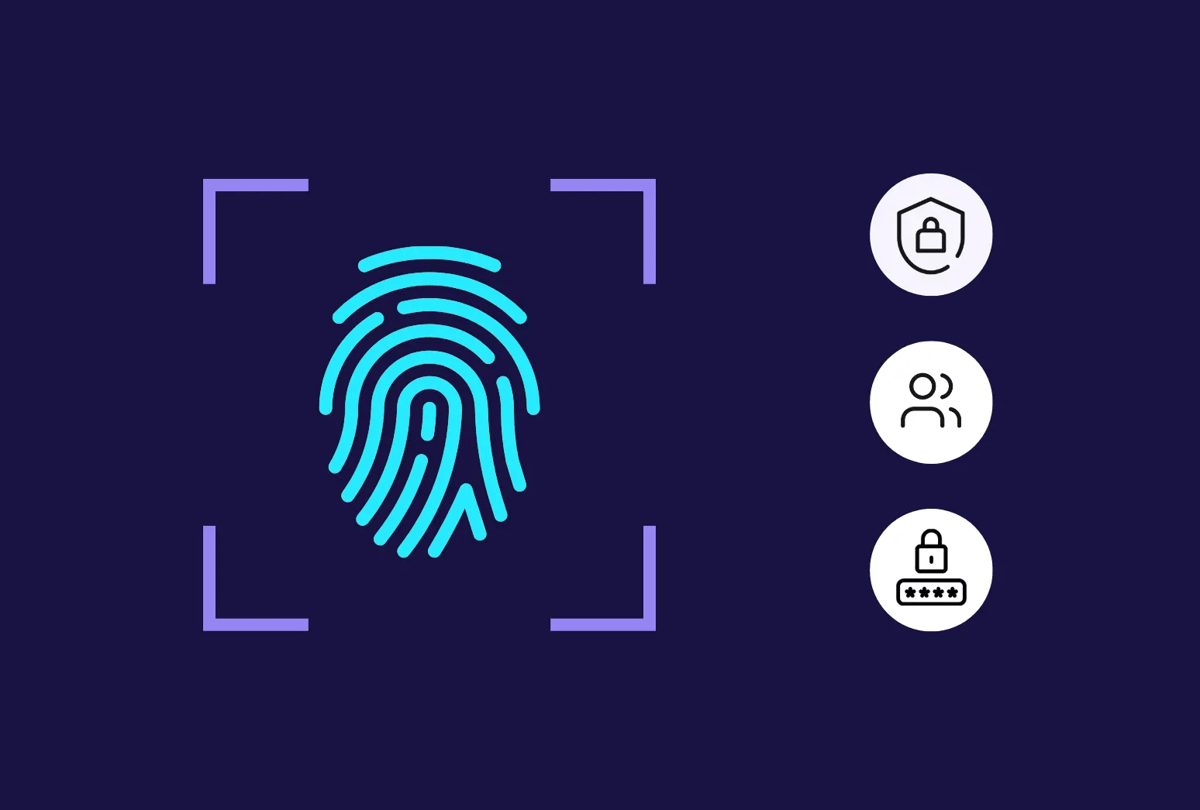
What is identity security?
Identity security is the modern evolution of Identity and Access Management (IAM). It arose as organizations shifted from on‑premises infrastructure to distributed cloud and SaaS environments, where traditional perimeter defenses could no longer protect users or data effectively.
Early IAM systems focused on verifying who someone was and granting access to specific applications. That approach worked in closed networks with centralized directories. Today, identity spans employees, contractors, service accounts, APIs, and even AI agents — each connection becoming a potential attack path.
Identity security extends IAM by continuously verifying trust, monitoring behavior, and detecting misuse across all identities, human and non‑human. It ensures that every access request remains legitimate and that privileges are adjusted or revoked as risk changes.
At its core, identity security enforces the principle of least privilege: only the right entities, with the right justification, can access the right data at the right time. It forms the foundation of Zero Trust architecture and the backbone of defense in modern SaaS and AI ecosystems.
The growing importance of identity security
Identity security has become the foundation of modern defense. As organizations move deeper into cloud and SaaS ecosystems, every user, service account, and integration becomes part of the security perimeter. Protecting those identities is now essential to maintaining trust, compliance, and operational continuity.
Traditional IAM tools were built for internal control, but significant risk comes from the connections between applications, vendors, and AI systems. That is where Vorlon delivers unique visibility and control.
Vorlon helps security teams see beyond login events and permissions to understand how identities, tokens, and data actually move across third‑party SaaS and AI tools. It turns that insight into practical action: detecting over‑scoped access, monitoring consents and data flows, and containing threats before they spread.
By securing the space between applications, Vorlon gives organizations the confidence that every identity in their SaaS and AI environment is visible, governed, and under control.
How does identity security differ from traditional identity and access management (IAM)?
Identity security builds on the foundation of IAM but expands its purpose from managing access to protecting trust. Traditional IAM systems were designed to authenticate users and assign permissions within controlled environments such as corporate networks or directories; all places with clear boundaries and predictable user sets.
In today’s distributed SaaS and AI ecosystems, those boundaries no longer exist. Identities now include employees, contractors, service accounts, APIs, and autonomous agents operating across dozens of third‑party platforms. Simply managing credentials is no longer enough. Organizations must continuously verify that every identity remains legitimate, behaves as expected, and accesses only what it should.
Identity security adds this layer of continuous verification and behavioral awareness to IAM. It transforms identity from a static access control mechanism into a dynamic security signal — one that detects anomalies, contains misuse, and ensures access stays appropriate over time.
The main differences between IAM and identity security fall into five key areas:
- Purpose and philosophy – IAM manages accounts, roles, and permissions to streamline authentication and provisioning. Identity security continuously verifies those identities, detecting misuse and containing credential‑based attacks before they spread.
- Scope of protection – IAM works best in fixed, well‑defined environments such as on‑premises directories or controlled enterprise apps. Identity security extends protection across SaaS and cloud ecosystems, covering all identities — human and non‑human — wherever they operate.
- Continuous verification – IAM typically authenticates once and assumes trust. Identity security treats trust as temporary, monitoring context and behavior in real time and revoking access as soon as risk appears.
- Technology and detection – IAM relies on directories, password management, and role‑based access control. Identity security employs continuous authentication, risk‑based access, and behavioral analytics to identify anomalies and prevent identity‑driven attacks.
- Security integration – IAM is primarily an operational IT function focused on efficiency and compliance. Identity security integrates with broader cyber defense, correlating identity signals with threat intelligence, SIEM, and detection systems to identify and contain identity misuse at scale.
Which types of identities must identity security encompass?
Identity security must protect every entity that can authenticate, access data, or act on behalf of your organization, whether human or machine. In modern SaaS and AI ecosystems, these identities extend far beyond employees. They include service accounts, APIs, devices, and applications that operate autonomously and often at scale.
Human identities
These are the people behind the screens — employees, contractors, partners, and customers. Each must be verified, monitored, and granted only the access they need.
- Workforce users: Employees, contractors, and interns remain primary targets for phishing, MFA fatigue, and privilege misuse. Controls include single sign‑on (SSO), phishing‑resistant MFA, least privilege, and regular access reviews.
- Privileged admins: Cloud, SaaS, and infrastructure administrators hold the keys to critical systems. Protect them with privileged access management (PAM), just‑in‑time (JIT) elevation, session recording, and segregation of duties.
- External or guest users: Partners and customers require limited, conditional access. Enforce strict onboarding/offboarding, restricted roles, and conditional access policies.
Non‑human (machine) identities
Machine identities such as APIs, bots, service accounts, and applications, now outnumber human ones in most enterprises. They authenticate, authorize, and perform actions without direct oversight, often with powerful privileges.
Identity security ensures these entities communicate only with authorized systems and follow least‑privilege principles.
- Service accounts: Used by applications or scripts. → Vault credentials, rotate regularly, monitor usage.
- Workload identities: Cloud roles or service principals. → Short‑lived tokens, workload identity federation, CIEM enforcement.
- API keys and tokens: Connect SaaS and platform APIs. → Minimize scope, rotate frequently, detect anomalies.
- Bots and automation tools: RPA bots and CI/CD runners. → Scoped permissions, signed requests, runtime constraints.
- Certificates and PKI identities: Used for mTLS and device authentication. → Automate issuance and revocation; store private keys securely.

According to Gartner®, "Machine identities significantly outnumber human identities, and this disparity is only expected to increase with the continued growth of cloud usage, automation, AI, integrations and bots."
What core tools and technologies support identity security?
Identity security depends on an ecosystem of tools that work together to protect, monitor, and manage every digital identity, whether human or NHI. These technologies form the foundation of a Zero Trust architecture, where trust is never assumed and access is always verified.
Identity and access management (IAM) forms the foundation, managing user identities, authentication, and access rights across systems to ensure that the right people and systems have the right access to the right resources. Leading platforms include Okta, Microsoft Entra ID (Azure AD), Ping Identity, and ForgeRock.
Identity threat detection and response (ITDR) adds an intelligence-driven layer that continuously monitors identity activity and responds to anomalies in real time, detecting threats such as credential theft or privilege abuse. Examples include CrowdStrike Falcon Identity Protection, Microsoft Defender for Identity, and Okta ThreatInsight.
Privileged access management (PAM) secures and monitors high-level accounts that can access critical systems or data, enforcing least-privilege access, protecting credentials, and recording privileged activity through tools like CyberArk, BeyondTrust, Delinea, and HashiCorp Vault.
Identity governance and administration (IGA) manages the entire lifecycle of identities—from onboarding through access certification to deprovisioning—maintaining compliance and ensuring users have appropriate, auditable access at all times. Key platforms include SailPoint, Saviynt, and Oracle Identity Governance.
Multi-factor and passwordless authentication (MFA) is core to Zero Trust, verifying users through multiple proofs of identity such as biometrics, tokens, or device trust. This eliminates reliance on passwords and blocks unauthorized logins even if credentials are stolen, using solutions like Duo Security, Microsoft Authenticator, YubiKey, and FIDO2 standards.
Single sign-on (SSO) strengthens security by centralizing authentication while improving user experience, enabling users to authenticate once and securely access multiple applications through platforms like Okta SSO, PingOne, and Auth0.
Zero trust network access (ZTNA) replaces VPNs with identity-centric, context-aware access control, verifying identity and context before granting access to resources regardless of user location or network. Solutions include Zscaler, Netskope, and Palo Alto Prisma Access.
User and entity behavior analytics (UEBA) integrate identity data with broader security analytics to correlate events and behaviors, uncovering malicious or abnormal identity use, insider threats, and compromised accounts through platforms like Splunk, IBM QRadar, Exabeam, and Microsoft Sentinel.
How can AI and automation improve identity onboarding, access certification, and threat detection?
AI and automation are modernizing identity security by replacing manual processes with intelligent, adaptive systems. They improve consistency, accuracy, and speed across onboarding, certification, and threat detection, turning identity management into a continuous, data‑driven process.
1. Smarter, faster identity onboarding
AI and automation streamline provisioning by assigning the right access automatically and reducing human error.
- Automated account setup: When a new user or service joins, AI tools assign accounts, roles, and permissions based on job function, department, and past patterns.
- Context‑aware access: Machine learning adjusts access dynamically using factors like location, device, and behavior.
- Error reduction: Automation eliminates manual setup mistakes that often lead to misconfigurations and security gaps.
2. Intelligent access certification
Access reviews often overwhelm teams with manual checks. AI eliminates noise by focusing attention where it matters.
- Risk‑based reviews: AI highlights outliers such as orphaned accounts or excessive privileges.
- Continuous validation: Machine learning continuously audits permissions and flags unused or expired access.
- Behavioral baselining: Systems learn normal access patterns for each role and detect deviations in real time.
3. Advanced threat detection and response
AI enhances visibility across identity ecosystems and reacts faster than human analysts.
- Anomaly detection: Behavioral analytics identify unusual login times, data use, or network activity tied to specific identities.
- Automated response: AI can revoke tokens, enforce MFA, or isolate sessions when it detects suspicious activity.
- Cross‑signal correlation: Identity events are analyzed alongside SIEM, endpoint, and network data to reveal hidden compromise paths.
4. Continuous learning and optimization
AI systems learn from every event to strengthen defenses over time.
- Adaptive policies: Access rules adjust automatically as user roles, systems, and threats evolve.
- Predictive defense: AI anticipates potential identity risks and tightens controls proactively.
Vorlon applies similar adaptive controls across connected SaaS and AI systems. See AI SaaS Security Use Cases.
What are the emerging threats targeting digital identities?
Every human or machine identity is a potential weapon if left unguarded. Consequently, attackers don’t chase systems anymore. They chase trust. Recent SaaS breach trends show this shift clearly, as detailed in 2025 SaaS Ecosystem Security Best Practices.
AI-powered phishing and deepfake attacks
Attackers are using generative AI to craft highly convincing phishing emails, fake login pages, and even synthetic voices or videos.
- Deepfakes can impersonate executives to approve transactions or trick employees into revealing credentials.
- AI-written phishing messages are grammatically flawless and contextually accurate, making them nearly indistinguishable from legitimate communication.
Other AI-enabled identity threats include the following:
- Prompt injection leading to tool abuse: LLM agents execute high-privilege actions via connectors.
- Sensitive data in prompts/logs: Exfil via model APIs or retained telemetry. Mitigations: Tool allowlists and least privilege for agents, DLP/redaction on prompts/outputs, training/retention opt-outs, approval gates for sensitive tool calls.
Identity-based lateral movement
Once attackers gain one identity, they move sideways or laterally, exploiting trust relationships between accounts, APIs, and cloud services.
- Compromised service accounts or API keys allow silent infiltration across systems.
- Attackers exploit over-permissioned identities to escalate privileges and reach sensitive assets.
Other workload and machine identity-based attacks, including the following:
- Metadata service abuse: SSRF to IMDS (e.g., IMDSv1) to steal cloud role credentials.
- Service principal sprawl: Over-privileged SPs with long-lived secrets; lack of rotation.
- K8s token theft and lateral movement: Compromised pods dump service account tokens; permissive RBAC. Mitigations: IMDSv2/metadata hop protection, workload identity federation (OIDC/SPIFFE) over static keys, secrets vaults with auto-rotation, CIEM to right-size roles, tight K8s RBAC and network policies.
Credential stuffing and session hijacking
Automated tools now test billions of stolen credentials across platforms, exploiting password reuse and weak MFA.
- Attackers also steal session tokens from browsers or memory, bypassing authentication altogether.
- Even with MFA in place, session hijacking allows attackers to impersonate legitimate users invisibly.
Other token and session theft/replay that fall under this banner include:
- Pass-the-cookie/session hijacking: Infostealers grab cookies from browsers/EDR exclusions.
- Refresh token theft and long-lived tokens: Persistent access even after password/MFA changes.
- Token exfiltration via logs/telemetry: Bearer tokens in app logs or crash dumps.
- Token substitution/DPoP bypass: Replay where token binding isn’t enforced. Mitigations: Short TTLs, continuous re-auth on risk, token binding (DPoP/MTLS), secure cookie flags, strict log redaction, device posture checks, and rapid session revocation.
Exploitation of machine and service identities
Non-human identities (APIs, bots, containers, and microservices) are growing exponentially and often lack proper governance.
- Attackers exploit hard-coded credentials, expired certificates, or unrotated keys to compromise automation chains.
- These machine identities can be used to exfiltrate data or deploy malware without detection.
Supply chain and federated identity compromise
Identity federation (e.g., SSO, OAuth, SAML) expands trust boundaries, and attackers target them directly.
- A breach in one trusted third-party service can expose multiple connected environments.
- Token manipulation and misconfigured trust relationships let attackers impersonate legitimate users across clouds.
Other Federation and signing-key compromises are:
- Golden SAML / SAML token forgery: Theft of token-signing certs (IdP/AD FS compromise).
- OIDC misconfig: Missing nonce/PKCE, weak redirect URI validation enabling code theft.
- Key/cert lifecycle gaps: Expired or unrotated signing keys increase exposure.
- Mitigations: When possible, prefer cloud-managed auth over legacy federation, harden/monitor IdP, rotate and protect signing keys (HSM), enforce PKCE/nonce, and strictly redirect URIs.
Insider threats and shadow identities
Not all threats come from outside. Employees, contractors, or abandoned accounts can also become entry points.
- Shadow identities encompass forgotten accounts, unused credentials, or unmonitored service accounts, and these often linger in systems, ripe for exploitation.
- Insider misuse, whether intentional or accidental, can bypass even the strongest perimeter defenses.
MFA fatigue and push-bombing attacks
Attackers exploit users’ trust in multi-factor authentication by overwhelming them with login requests until they approve one by mistake.
- MFA fatigue attacks manipulate human behavior instead of code.
- Combined with social engineering, they turn strong defenses into human error.
Related credentials and MFA bypass evolution attacks include:
- Phishing-as-a-service and AiTM proxies: Steal passwords and MFA codes, then capture session cookies in real time.
- MFA fatigue/push bombing: Spam approvals to trick users.
- Browser-in-the-browser (BitB) and QR-code phishing: Spoof SSO windows or move auth to mobile.
- Deepfake/vishing-assisted account recovery: Social-engineer helpdesk to reset access.
- Mitigations: Phishing-resistant MFA (FIDO2/WebAuthn), number-matching and geofencing for pushes, challenge-based helpdesk flows, conditional access, and user training with simulated AiTM attacks.
Cloud misconfigurations and identity drift
In dynamic cloud environments, misconfigured roles, excessive privileges, or orphaned identities open invisible backdoors.
- Attackers exploit “identity drift,” where permissions expand unnoticed over time.
- These weaknesses are often discovered too late, after data has already been taken.
Why is treating AI agents as identities essential for accountability and security?
AI agents authenticate, call APIs, read data, and take actions just like users or service accounts. When you give an AI agent power to write code, move funds, approve access, or analyze private data, you've created a new kind of identity: One that never sleeps, never forgets, and can scale faster than any human.
Without identity controls, that power is blind. You can't track what the agent accessed, what it changed, or when it crossed a line. You can't revoke its rights, rotate its keys, or hold it accountable. Treating AI agents as first-class identities brings them into the realm of governance. You apply least privilege, enforce authentication and authorization, and maintain audit trails, just as you would for any user or service.
If an AI can act, it must be seen. If it can decide, it must be governed. Vorlon builds on this principle with unified SaaS and AI security, ensuring that every agent, whether human, machine, or algorithm, is accountable under the same identity framework.
Why identity-grade treatment is essential for AI agents
Identity-grade treatment delivers accountability you can audit. Every action ties to a distinct agent principal with a clear owner, purpose, and scope, producing tamper-evident traces for prompts, tool calls, and outcomes. This enables real incident response. You can revoke an agent's sessions or tokens, quarantine its outputs, and rotate credentials without breaking other applications.
Least privilege becomes enforceable by design. Instead of blanket API access, you grant fine-grained, time-boxed permissions per agent and per tool, preventing tool misuse and data overreach from prompt injection or chain-of-thought leakage. Segregation of duties for autonomy separates "read data," "draft change," and "execute change" scopes, requiring human-in-the-loop approval for sensitive actions.
Compliance and data governance become manageable. You can map agent access to ISO and NIST controls, enforce residency and retention requirements, and redact PII in prompts and outputs. You prove who accessed what, when, and why across audits and TPRM reviews. A secure supply chain for models and tools lets you track model versions, plugins, and data sources, verify provenance, and block unapproved components.
What does "treat agents as identities" mean in practice?
Treating agents as identities means applying the same rigor you use for human and service accounts. Each agent receives unique principals and credentials—its own identity (service account or workload identity) with short-lived, rotated tokens. Strong authentication and authorization follow: SSO or OIDC to model providers and tools, RBAC or ABAC per action and dataset, and just-in-time elevation for privileged steps.
Tool permissions are scoped and explicit. You allowlist which tools and functions an agent can call, constrain arguments, and apply rate limits and egress controls. DLP and privacy guardrails redact PII and PHI from prompts and logs, label sensitivity, and apply retention and legal holds to traces. Policy-as-code guardrails codify who, what, and where an agent can access, blocking high-risk actions without approvals.
Full-fidelity observability captures every action. You log prompts, retrieved context, tool calls, outputs, and decisions, storing hashes or watermarks for integrity. A safe autonomy loop requires step-up approval for irreversible actions and provides dry-run or diff modes with rollback plans.
In short, identity-grade treatment transforms AI agents from unmonitored superusers into governed, accountable actors within your security framework.
How can Vorlon help with identity security?
Most identity and access management programs stop at people and roles. But in today’s SaaS and AI ecosystems, many of the most powerful identities aren’t human at all—they’re service accounts, OAuth apps, API tokens, and AI agents operating across dozens of platforms. Maintaining security compliance means controlling every one of them.
Vorlon brings this hidden layer of identity into view. It continuously maps how users, applications, and automated processes connect and exchange data across your SaaS environment, building a real-time inventory of who has access to what and how that access is being used. This visibility extends beyond traditional IAM boundaries, closing the blind spots where many compliance gaps begin.
With Vorlon, security teams can:
- See every identity—human, service, and AI—across connected SaaS applications.
- Detect excessive or unused permissions before they become incidents.
- Track OAuth and API token activity for risky scopes or long-lived access.
- Maintain audit-ready evidence of access changes and policy enforcement.
Because SaaS access expands over time, Vorlon establishes a baseline of normal behavior and monitors for drift. It highlights unused or over-scoped permissions, dormant global admins, and risky sharing settings such as public links or unmanaged devices. When controls weaken, Vorlon provides clear, prioritized steps to reduce exposure safely.
Access governance now includes machines as well as people. Vorlon treats AI agents as identifiable entities with owners, scopes, and credentials—tracking how they interact with data, which connectors they use, and how their permissions evolve. This unified approach to human and non-human identities is central to Vorlon’s AI SaaS Security framework.
Behind the scenes, Vorlon correlates signals from sign-ins, admin changes, consents, token use, and data sharing to detect potential account takeover or consent abuse. It integrates with existing SIEM and SOAR systems to give investigations complete context—who acted, through which app, and what data was involved. These capabilities are part of the Vorlon Platform, which maintains posture history and evidence to demonstrate control during audits.
In short, Vorlon delivers continuous visibility into all identities—human, service, and AI—and the data flows that connect them. By unifying that visibility, it helps organizations maintain compliance and security in environments that evolve faster than traditional IAM or point tools can follow.
1Gartner, Innovation Insight: Improve Security With Machine Identity and Access Management, Steve Wessels, Felix Gaehtgens, Michael Kelley, Erik Wahlstrom, 11 March 2025. GARTNER is a registered trademark and service mark of Gartner, Inc. and/or its affiliates in the U.S. and internationally and is used herein with permission. All rights reserved.


.jpeg?width=400&height=300&name=6542e59219b3d7d6cbd1115f_AdobeStock_207409033%20(1).jpeg)
.png?width=329&height=222&name=blog%20451%20why%20saas%20and%20ai%20are%20converged%20(1).png)