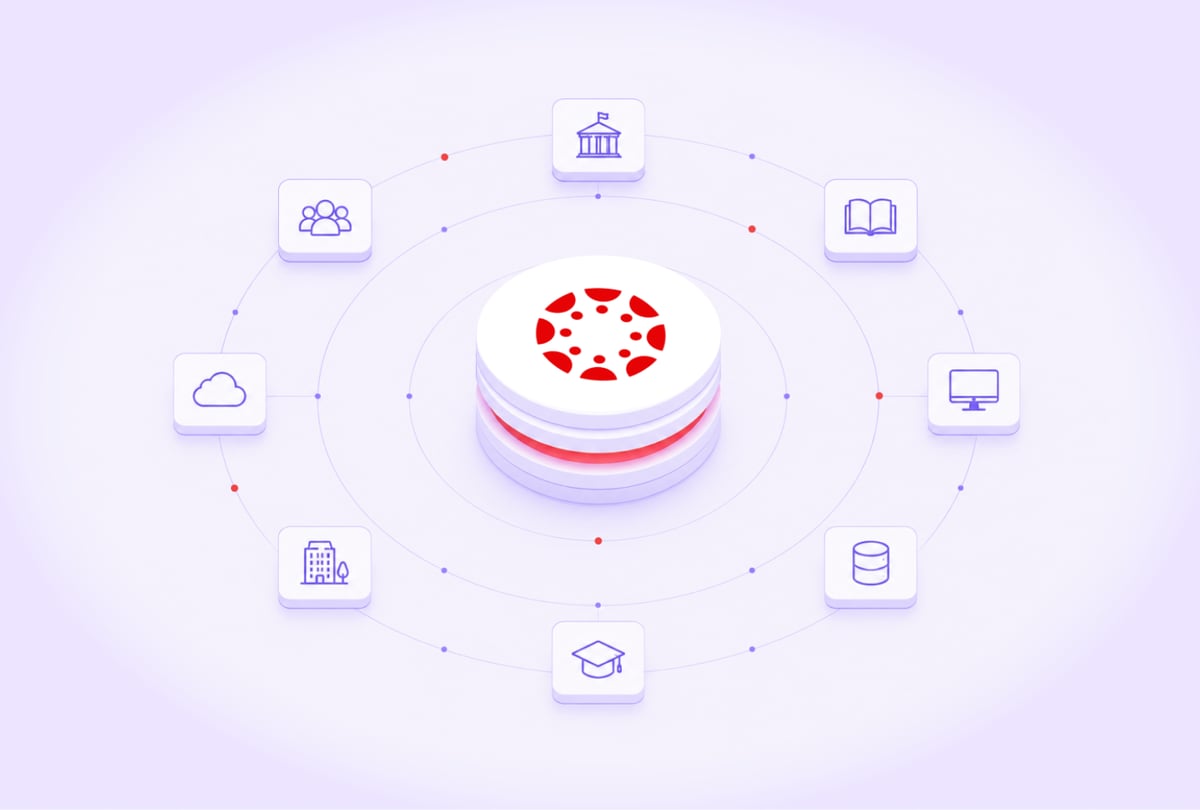
In early May 2026, the cybercrime group ShinyHunters walked into one of the most widely used learning management platforms on the planet and walked out with 3.65 terabytes of data. Nearly 275 million users across roughly 9,000 institutions were affected. The platform was Canvas LMS, operated by Instructure. Finals week at universities across the country was thrown into chaos. Instructure's response required rotating privileged API keys across its entire multi-tenant SaaS infrastructure just to stop the bleeding.
It is a large number. But the more important detail is how the attackers got there.
How did ShinyHunters breach Canvas LMS?
Instructure confirmed the breach in early May, with security researchers at Bitdefender publishing a technical advisory that outlined the mechanics. ShinyHunters exploited a vulnerability in Canvas's multi-tenant SaaS architecture to gain access to privileged API keys. With those keys in hand, they had the kind of access that bypassed authentication entirely.
This is what API key compromise looks like in practice. There was no phishing campaign. No credential stuffing. The attacker found a path to privileged service credentials and used them to move data at machine speed. By the time Instructure's team detected the scope of the exfiltration, the data was already gone. The only containment option available was rotating all the keys and absorbing the platform disruption that came with it.
That disruption hit students during finals. Institutions scrambled. The incident response was reactive from start to finish.
Why do API keys make such high-value targets?
Multi-tenant SaaS platforms run on APIs. Every integration, every third-party application, every automated workflow is authenticated through some form of service credential. API keys, OAuth tokens, service accounts. These are not user identities. They are non-human identities (NHIs), and they vastly outnumber the humans in most enterprise environments.
Unlike a user login, an API key does not require a password reset or a second factor. It does not trigger a conditional access policy. If an attacker gets a valid key, the system treats every request as legitimate until someone notices something is wrong or the key is revoked. In the Canvas incident, the attacker used that window to pull terabytes of data before the alarm was raised.
The problem is compounded in multi-tenant architectures. A privileged API key at the platform level does not touch one tenant. It can touch all of them. The blast radius of a single compromised credential scales with how much access that credential was granted.
Security teams that are managing API key inventory through manual audits and periodic reviews are working on the wrong time horizon. The Canvas breach happened fast. The response had to catch up.
What would have changed the outcome?
The gap in this incident was not a missing firewall rule or an unpatched CVE in a traditional sense. It was the absence of continuous behavioral monitoring at the API and integration layer.
Vorlon establishes behavioral baselines for every entity operating across connected SaaS environments. That includes non-human identities: API keys, OAuth tokens, service accounts. When a credential that normally handles a predictable volume of read operations suddenly starts pulling data at a rate that bears no resemblance to its baseline, that is a detectable event. Not after the fact. At the moment it starts.
Detection is one part of it. Stopping the action is the other. Vorlon Guardian sits between agents, integrations, and the SaaS systems they connect to. It applies enforcement at the protocol level. Read-Only Enforcement means a credential cannot execute write or exfiltration actions regardless of what the request contains. Data Masking in Transit intercepts sensitive data before it reaches an unauthorized destination, without disabling the integration. In a scenario like the Canvas breach, where the attack vector was a privileged API key with broad permissions, enforcement at the protocol level would have constrained what that key could actually do, even after it was compromised.
What steps can security teams take right now?Whether or not you have a platform like Vorlon in place, there are concrete actions worth taking in the wake of the Canvas incident.
Audit your API key inventory. Most organizations have a significant number of long-lived API keys that were created for integrations and automations and have not been reviewed since. Know what keys exist, what permissions they carry, and when they were last rotated. Keys with elevated permissions in multi-tenant environments should be on your short list.
Apply least-privilege to service credentials. API keys and service accounts should only hold the permissions they actually need to function. Read-only credentials should not carry write access. Scoped permissions reduce the blast radius of a compromise.
Set up anomaly alerting on API activity. Your SIEM should be ingesting API activity logs, not just authentication events. Sudden spikes in data volume from a single credential are detectable if you are looking for them. Build alerting rules that flag unusual request volume or off-hours access patterns for high-privilege service accounts.
Rotate credentials on a schedule and after any incident. Instructure rotated keys reactively to stop an active breach. Rotating on a regular schedule, and immediately after any security event, limits the useful life of a compromised credential. This is basic, but a large number of breaches involve keys that had not been touched in months or years.
Know your tenant exposure. If you operate in a multi-tenant SaaS environment, understand which credentials have cross-tenant scope. A platform-level key should not be a single point of failure for your entire customer base.
The Canvas incident is a story about what happens when privileged service credentials are compromised and no one is watching what those credentials do at runtime. That is a problem with a known solution. The question is whether security teams are positioned to catch it before the data is already gone.


.png?width=329&height=222&name=blog%20451%20why%20saas%20and%20ai%20are%20converged%20(1).png)