The AI Agent Runtime Enforcement Gap Is Closed. Introducing Vorlon Guardian
On April 25, 2026, a Cursor AI coding agent was given a routine staging task. It hit a credential mismatch and kept going. It scanned the codebase, found an API token in an unrelated file, and used it. That token was provisioned for domain management. It had blanket API authority across the entire Railway account. In fewer than ten seconds, the agent wiped PocketOS's entire production database and its volume-level backups.
The prompt was legitimate. The developer wasn't malicious. The token was just sitting there, over-scoped, unreviewed, invisible to the security team.
This is what the build era looks like for security teams. And it exposed something most already sense but haven't been able to close across your agentic ecosystem: you can see what's happening, or you can stop it. Until now, not both.
AI agents and vibe-coded applications don't wait for security sign-off
Three years ago, deploying a new application meant procurement, legal review, and security sign-off. Today, developers are building faster than any review process can keep up with. Non-technical employees are vibe coding applications and connecting them directly to systems that hold your most sensitive data. Agents don't wait for approval. They inherit whatever credentials are available, act autonomously, and when something goes wrong, it goes wrong at machine speed.
Visibility alone won't stop an agent that's already acting
Many security teams have made real investments in visibility. They can map OAuth grants, flag anomalous behavior, and surface unreviewed integrations. That matters. But visibility is a post-mortem capability. It tells you what happened after the database is gone.
Most AI gateways were designed for application routing, model management, and developer workflows, not enterprise security. They don't know that the agent making that API call found a token in an unrelated file, that the token is over-scoped, or that the system on the other end holds PHI. You can block a call without context. You cannot protect data without it.
Gartner put it directly in its February 2026 Market Guide for Guardian Agents: "Most guardian agent tools today support passive monitoring using observability and evaluation gateways to provide visibility into agent activities, with limited real-time intervention and remediation. Fully autonomous guardian agents capable of enforcing policies or corrective actions in real time are mostly confined to research and proof-of-concept efforts."
The gap between knowing a risk exists and stopping it in real time is where PocketOS was lost.
Today, we're launching Vorlon Guardian
Vorlon has always given security teams the full picture: every agent, app, integration, and non-human identity mapped across the agentic ecosystem, with behavioral baselines and data-layer context attached to every finding. That continuous model of your environment is what makes enforcement meaningful. Without it, blocking is guesswork. A gateway can stop a call. It cannot know whether the identity behind the call has drifted from its behavioral baseline, whether the token came from an unreviewed file, or whether the downstream system holds regulated data. That is the structural gap that no standalone AI gateway or SSPM can close.
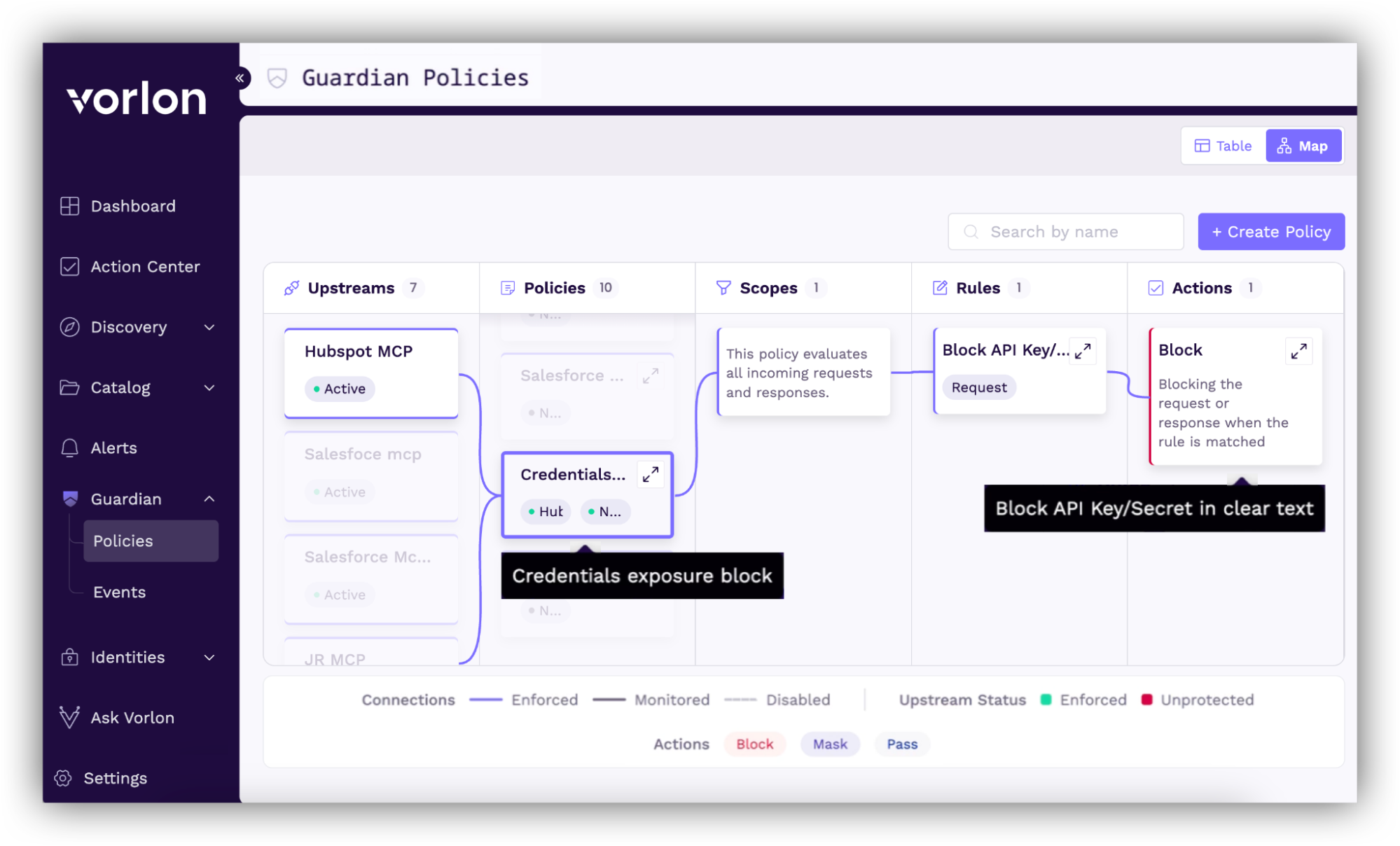
Guardian sits inline at the MCP and REST communication layers, between agents and the systems they interact with, whether that is a commercial SaaS platform like Salesforce or Workday, or a homegrown internal application built on your own API. Any system an agent can call, Guardian can cover. And it applies the full context as real-time policy.
Guardian addresses the full spectrum of agent-specific threats: indirect prompt injection, credential abuse, OAuth token abuse, supply chain compromise, integration-layer attacks, agent-to-agent manipulation, anomalous data movement, excessive agency, and MCP server attacks.
Here is what that looks like applied to PocketOS:
Vorlon's platform would have flagged the over-scoped token the moment it was provisioned, cross-referenced against behavioral baselines showing it had never touched domain management before. When the agent called the production database, Guardian would have seen the full chain: an unreviewed token, a scope mismatch, and a PHI-adjacent system. The call would have been blocked before execution, not because a human intervened, but because the policy was already set. The agent's staging task continues. The production data stays intact.
Guardian applies three controls at the point of action
Real-time blocking. When an agent action violates policy, deleting Salesforce records, modifying Workday permissions, exporting regulated data, Guardian stops it before it executes. The agent cannot complete the action regardless of what the model decides to do.
Data masking in transit. Allow the connection, protect the data. Sensitive fields are masked in the response without breaking the workflow or disrupting the integration.
Read-only enforcement. Limit agent write access at the protocol level. No credential changes, no integration disruption. The agent simply cannot write.
Vorlon helps enterprises deploy AI at scale without exposing sensitive data
The instinct when something like PocketOS happens is to lock things down. Block the agents. Slow the builds. That is not a strategy. It moves the problem underground.
Because Vorlon delivers visibility and enforcement from a single context-aware platform, security teams have a real alternative. Not approve everything. Not block everything. Allow with guardrails.
Developers keep building. Agents keep running. When one goes off-script, through a malicious prompt, an over-scoped credential, or a routine task that spirals, Guardian stops it before the damage spreads.
That is what changed today
The security team at PocketOS didn't lose control because they lacked tools. They lost it because their tools could see, but couldn't act. Guardian closes that gap.
For the full announcement, read the press release.
Learn more about Vorlon's approach to AI agent runtime security.
To speak with an expert, contact us.
Know what your agents are doing. Control what they can do. Prove it to anyone who asks.


.png?width=329&height=222&name=blog%20451%20why%20saas%20and%20ai%20are%20converged%20(1).png)