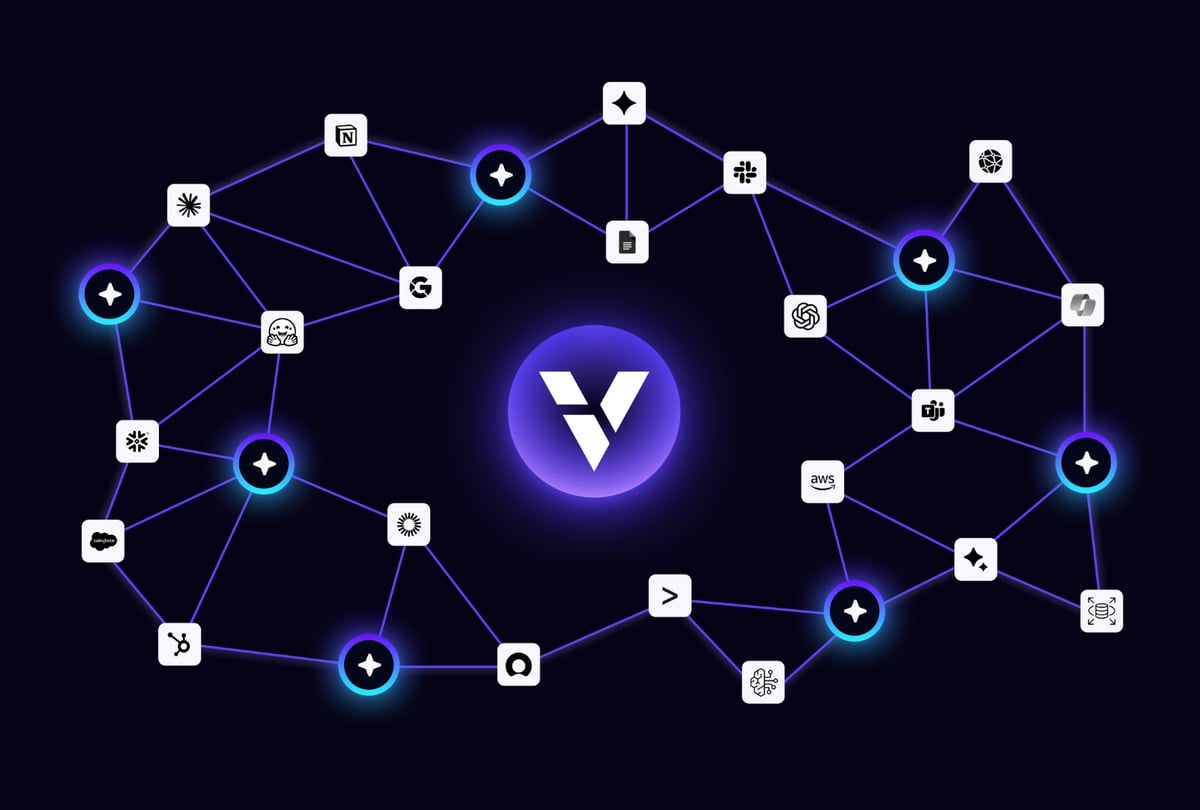
In 2025, over 1,000 organizations were breached through trusted SaaS integrations rather than perimeter failures. Attackers utilized authorized OAuth tokens, legitimate API calls, and connected third-party services that sit outside the view of traditional security monitoring.
Agentic ecosystem security is the practice of protecting the interconnected environment where AI agents, SaaS applications, APIs, and non-human identities operate, move sensitive data, and communicate at machine speed. It addresses the backend execution layer that user-centric security tools were not architected to cover.
Most enterprise security architectures are designed for human-speed, browser-based interactions. They secure the user at the edge but lack visibility into the backend layer where agents authenticate, exchange data, and trigger automations. As enterprises deploy autonomous AI at scale, this visibility gap becomes a primary attack surface.
This page defines the agentic ecosystem security category, explains how agentic ecosystems differ from standard SaaS environments, identifies the specific threats this category addresses, and outlines the capabilities required to govern them.
What makes an agentic ecosystem different from a standard SaaS environment?
The defining characteristic of an agentic ecosystem is machine-to-machine (M2M) communication at scale. In a standard SaaS environment, a human logs in, takes an action, and logs out. In an agentic ecosystem, AI agents authenticate into SaaS applications, move sensitive data through APIs and Model Context Protocol (MCP) communications, and trigger downstream automations without direct human oversight.
This shift creates three structural differences from traditional SaaS security:
- Identity Volume: Non-human identities; including service accounts, API keys, OAuth tokens, and AI agent credentials, now outnumber human identities in most enterprise environments by a 50:1 ratio, according to 451 Research.
- Velocity: Machine-speed operations generate a volume of API traffic that human-centric monitoring cannot evaluate in real time.
- Boundary Dissolution: Because agents operate across multiple SaaS platforms simultaneously, the attack surface is no longer bounded by a single application or user session.
Shadow AI compounds this exposure. According to Gartner®, 59% of senior cybersecurity professionals suspect or have evidence of unsanctioned AI agent automation used by employees.¹ These shadow agents often operate without inventory, baselining, or governance.
The scale of the agentic shift
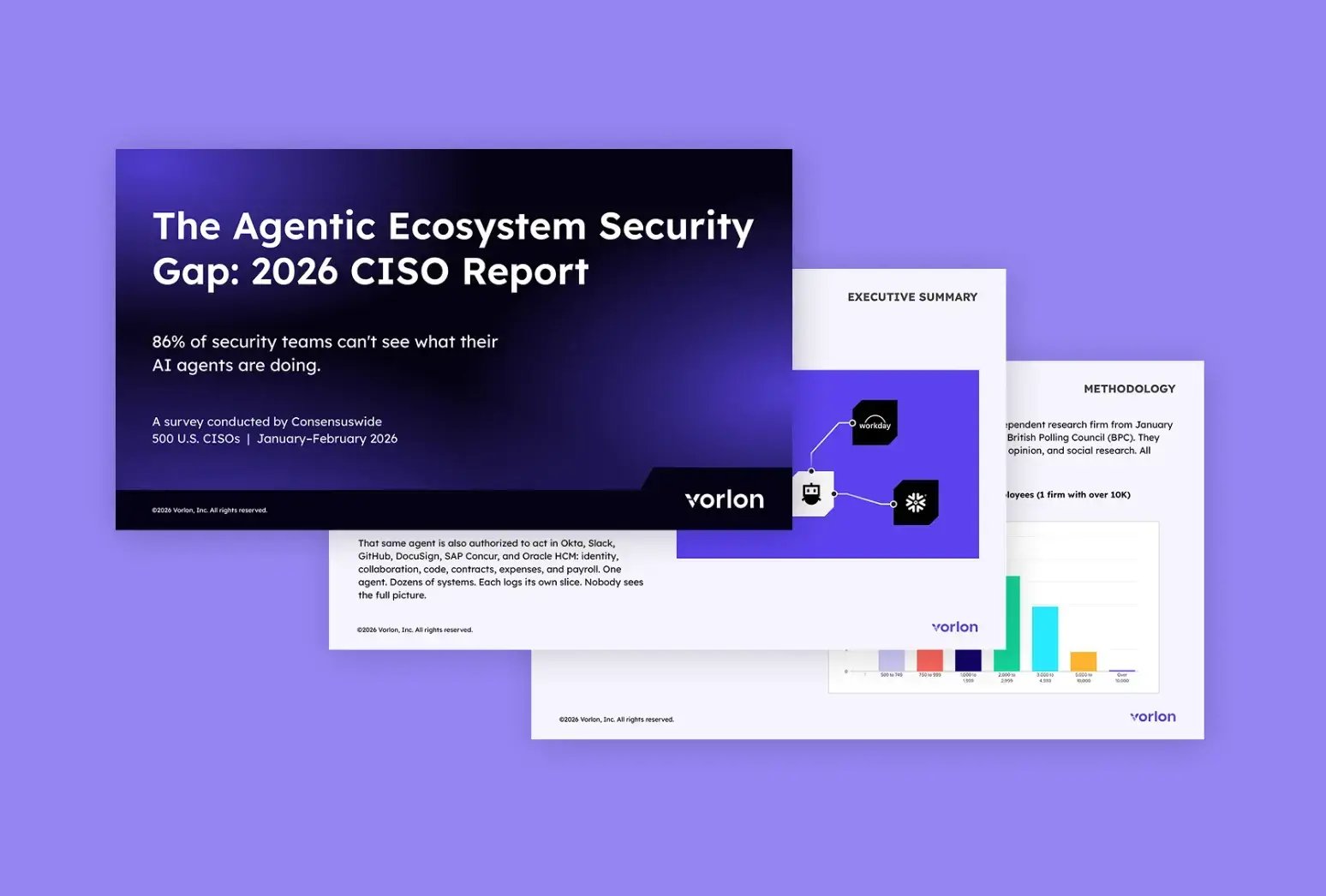
- 1 in 3 enterprises experienced suspicious AI agent activity in 2025 (Vorlon, The Agentic Ecosystem Security Gap: 2026 CISO Report)
- 50:1 ratio: Non-human to human identities in enterprise environments (451 Research)
- 61% of senior cybersecurity professionals observed AI agent automation from approved enterprise software (Gartner)
- 59% suspect or have evidence of unsanctioned AI agent automation (Gartner)
- By 2028, 80% of organizations will see AI agents consume the majority of their APIs (Gartner)
- 89% of CISOs agree that current human-centric tools cannot stop agentic attacks (The Mind of the CISO)
Why do traditional security tools struggle to protect the agentic ecosystem?
Traditional security tools were built for a different threat model. CASB and SASE tools control user-to-application traffic at the edge. SSPM tools assess configurations inside individual SaaS applications. DSPM tools discover sensitive data at rest in cloud repositories. Each tool addresses a specific domain, but none are designed to observe data and operations in motion across the backend where agents execute.
According to Gartner®, “The autonomous nature of agents introduces novel and rapidly escalating security and operational risks that legacy controls cannot manage.”²
The architectural limitation is visibility. Traditional tools monitor the "front door"—the login event, the browser session, the MFA challenge. They miss the "engine room," where agent-to-SaaS and SaaS-to-SaaS data flows occur through APIs and MCP communications without a user session. When an OAuth token is compromised or an AI agent moves customer records to an external endpoint, tools that inspect edge traffic or static configurations lack the context to detect the event.
- Agent-to-SaaS data flows through APIs and MCP communications
- SaaS-to-SaaS integrations running without human initiation
- Non-human identities operating with stale or overprivileged credentials
- Shadow AI agents and tools deployed outside IT procurement
- Blast radius when a connected vendor, token, or agent credential is compromised
What threats does agentic ecosystem security address?
Agentic ecosystem security focuses on three threat categories validated by the OWASP Top 10 for Agentic Security and the analyst community.
Identity abuse (OWASP ASI03) Agents can escalate privileges or reuse stolen session tokens to access restricted data. Without behavioral monitoring tied to data-layer context, a compromised agent credential is indistinguishable from authorized activity. Static permission checks cannot detect when an authorized agent begins behaving anomalously.
Malicious third-party access (OWASP ASI04) Agents connect to third-party tools, MCP servers, and vendor APIs. When a link in that supply chain is compromised, connected agents inherit that risk. A vendor breach effectively becomes a pathway into the enterprise's core systems through trusted integration channels.
Data exposure (OWASP ASI06) Sensitive data, including PII, PHI, financial records, and credentials, can leak into agent memory, public storage buckets, or external systems through API calls that bypass endpoint-based DLP controls. Gartner projects that through 2029, over 50% of successful cybersecurity attacks against AI agents will exploit access control issues.³
Third-party risk in the agentic ecosystem A vendor breach in an agentic ecosystem is not just a vendor problem. Every SaaS application and AI agent connected to that vendor through OAuth tokens, API keys, or MCP communications becomes a potential exposure point. Without blast radius analysis, security teams cannot determine the scope of exposure until the incident is well underway.
How does agentic ecosystem security differ from SSPM, CASB, and DSPM?
Agentic ecosystem security complements existing categories by addressing the observability of data and operations in motion.
- SSPM indicates who could access data based on current configurations. Agentic ecosystem security shows who did, how the data moved, and what was exposed at the data layer.
- CASB controls traffic from user to application at the edge. Agentic ecosystem security monitors traffic from agent to SaaS and SaaS to SaaS, which runs outside user sessions.
- DSPM classifies sensitive data at rest. Agentic ecosystem security tracks that data as it moves between applications and agents in real time.
The practical difference is evident during incident response. When a vendor announces a breach, SSPM can identify OAuth apps connected to that vendor. Agentic ecosystem security identifies which sensitive data categories those connections can reach, which AI agents have passed data through those connections, and the immediate blast radius. This distinction allows security teams to quantify exposure rather than relying on vendor assurances.
What existing tools provide
- SSPM: Configurations and permissions per SaaS app
- CASB/SASE: User-to-app edge traffic inspection
- DSPM: Sensitive data discovery and classification at rest
- NHI tools: Inventory of tokens and service accounts
What agentic ecosystem security adds
- Data and operations in motion across the full ecosystem
- Agent-to-SaaS and SaaS-to-SaaS data flow visibility
- Behavioral monitoring of non-human identities tied to sensitive data
- Blast radius analysis within minutes of a compromise
What capabilities define an agentic ecosystem security platform?
An agentic ecosystem security platform covers five functional areas to provide the necessary supervision layer:
- Ecosystem-wide observability: A live map of SaaS applications, AI agents, API integrations, OAuth connections, and MCP communications, including shadow tools that bypass corporate gateways.
- Behavioral threat detection with data-layer context: Continuous monitoring of identity behavior relative to baselines, correlated with specific sensitive data categories. This detects anomalous access patterns and token misuse that resemble normal API traffic.
- Non-human identity security: Inventory and governance of service accounts, API keys, OAuth tokens, and AI agent credentials.
- API endpoint data classification: Identification of sensitive data (PII, PHI, PCI, credentials) by analyzing API endpoints and traffic patterns without requiring invasive content inspection.
- Coordinated, automated response: Prescriptive remediation routed to application owners and automated workflows for token revocation and integration disabling.
Agentic ecosystem security is the practice of discovering, monitoring, and governing the interconnected environment where AI agents, SaaS applications, APIs, and non-human identities move sensitive data. It covers the backend execution layer that traditional perimeter, endpoint, and per-app security tools cannot reach.
How Vorlon approaches agentic ecosystem security
Vorlon operates as a dedicated Agentic Ecosystem Security Platform. It utilizes DataMatrix™, an intelligent simulation technology that ingests telemetry from SaaS and AI tools, API and MCP communications, users, and non-human identities. This builds a live model of the enterprise's ecosystem, revealing how sensitive data and automations move between applications.
Vorlon aligns with the approach described in Gartner’s “2025 Emerging Tech: Intelligent Simulation Accelerates Proactive Exposure Management” report, which notes that intelligent simulation shifts focus from reactive detection to preemptive cybersecurity.
The platform deploys without agents or proxies, connecting via read-only APIs to cover backend traffic, including shadow AI agents and integrations. When threats are detected, Vorlon routes contextualized remediation to application owners or triggers workflows across the security stack. For example, customers like Splitit have used this data-layer context to accelerate incident response, identifying which data and identities are affected by a vendor breach or compromised credential in minutes.
What security teams should do next
Agentic ecosystem security addresses the gap created by the scale deployment of autonomous AI. The attack surface has shifted from the perimeter to the backend, where agents and non-human identities operate beyond the reach of traditional tools.
Security teams should begin with an inventory: determine the count of non-human identities, the percentage of agent-driven API traffic, and the current level of visibility into SaaS-to-SaaS data flows. This inventory defines the scope of the gap.
For a deeper look at where the security stack breaks down, read The Enterprise Security Stack Has a Blind Spot. To understand the shift in attack surface, read Front Door vs. Engine Room: How AI Agents Redefined the Attack Surface.
Footnotes
¹ Gartner, Cybersecurity Trend: Agentic AI Demands Program Oversight, 2025 (Report ID 7326630). GARTNER is a registered trademark and service mark of Gartner, Inc. and/or its affiliates in the U.S. and internationally and is used herein with permission. All rights reserved.
² Gartner, AI Agents: Strategic Imperatives for CIOs (Report ID 7177531). GARTNER is a registered trademark and service mark of Gartner, Inc. and/or its affiliates in the U.S. and internationally and is used herein with permission. All rights reserved.
³ Gartner, How MCP and the A2A Protocols Impact API Management (Report ID 6881266). GARTNER is a registered trademark and service mark of Gartner, Inc. and/or its affiliates in the U.S. and internationally and is used herein with permission. All rights reserved.


.png?width=329&height=222&name=blog%20451%20why%20saas%20and%20ai%20are%20converged%20(1).png)