TOTAL IDENTITY SECURITY
Identity threat detection and response for the agentic ecosystem.
See and stop identity-based threats across human users, non-human identities, and AI agents — without replacing your IAM or IdP.
who put their trust in Vorlon
.svg)



-1.svg)


Service accounts, OAuth tokens, API keys, and AI agent credentials exploited directly, without a human account ever being compromised

Dormant and orphaned credentials
Projects end, vendors offboard, employees leave, but their credentials remain active and unmonitored

Secrets and OAuth token sprawl
SaaS apps and AI tools connected without security review, creating silent access paths

AI agents acting autonomously
Agents with delegated permissions accessing multiple systems at machine speed, indistinguishable from normal usage

Compromised human users
Account takeover leading to lateral movement through non-human identities and integrations
Service accounts, OAuth tokens, API keys, and AI agent credentials exploited directly, without a human account ever being compromised
Dormant and orphaned credentials
Projects end, vendors offboard, employees leave, but their credentials remain active and unmonitored
Secrets and OAuth token sprawl
SaaS apps and AI tools connected without security review, creating silent access paths
AI agents acting autonomously
Agents with delegated permissions accessing multiple systems at machine speed, indistinguishable from normal usage
Compromised human users
Account takeover leading to lateral movement through non-human identities and integrations
“Through 2029, over 50% of successful cybersecurity attacks against AI agents will exploit access control issues.”

Identity security from discovery to response

Ecosystem-Wide Identity Discovery
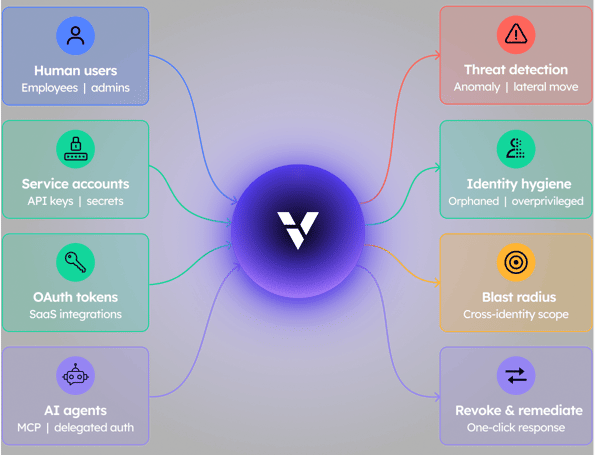
All identities across SaaS apps, IdPs, integrations, and AI tools: human users, service accounts, OAuth tokens, API keys, secrets, bots, and AI agent credentials. See how they connect and which sensitive data they reach.

Identity Posture and Hygiene
SSO/MFA posture, permission creep, dormant credentials, orphaned accounts, overprivileged AI agent access. Surface the identities that matter most.

Behavioral Identity Threat Detection (ITDR)
Token misuse, credential abuse, account takeover, insider misuse, AI agent anomalies. Correlate identity behavior with actual sensitive data access — not just login events.

AI Agent Identity Monitoring
Baseline agent behavior. Detect when agents access data outside their intended scope, connect to unauthorized systems, or exhibit anomalous patterns.

Fast, Coordinated Response
Revoke or restrict access in two clicks. Route actions to IdPs and app owners. Trigger workflows in SIEM, SOAR, and ITSM.

Audit-Ready Identity Evidence
Identity-to-data mappings for SOC 2, ISO 27001, HIPAA, PCI DSS. Continuous monitoring evidence without weeks of manual collection.
Identity tools see credentials. Vorlon
sees what they do with your data.
NHI / Identity Tools
Inventory credentials and tokens
Static risk scoring based on permissions
Focused on the credential itself
Agent lifecycle management
Alert on credential anomalies
Remediate credentials

Inventory + behavioral monitoring + data-layer context
Dynamic scoring based on actual behavior and sensitive data exposure
Focused on which sensitive data each identity reaches and accesses
Runtime behavioral supervision — what agents actually do
Alert with full context: which identity, which data, blast radius
Remediate across the ecosystem — identities, integrations, and data paths
Customer testimonials


"Vorlon solves a problem that's existed for over a decade."


"Vorlon provides a centralized view of our third-party security across multiple identity providers, cloud platforms, applications, and users."
.png?width=436&height=460&name=anthony-lee-masis%202%20(1).png)