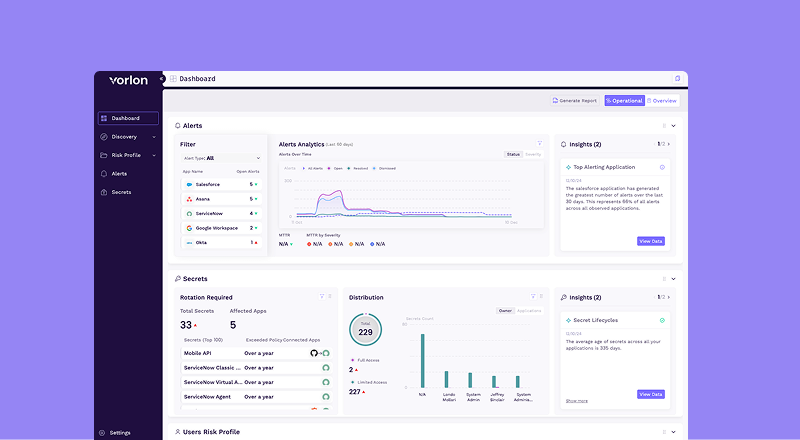
Vorlon is the Agentic Ecosystem Security Platform. Its patented DataMatrix™ technology creates a live model of how sensitive data flows across applications, integrations, and AI tools, providing native visibility into the data layer from day one.
General summary
Obsidian Security is a SaaS security platform combining SSPM and identity threat detection. Its Knowledge Graph unifies identity and permissions across SaaS apps, with recently expanded capabilities for supply chain visibility and AI agent monitoring.
Key strengths
Key strengths
Observes data and operations in motion across the entire agentic ecosystem — SaaS apps, AI agents, integrations, and non-human identities. API endpoint analysis classifies PII, PHI, PCI, and secrets without content inspection. Unified view of human and non-human identities with data-layer context. Prescriptive remediation routed directly to app owners. Agentless deployment with zero operational friction.
93% faster incident response — Splitit
Behavioral detection with data-layer context" — this is our core differentiator language and it's missing from the overview table
Key strengths
Strong identity threat detection and UEBA capabilities. Extensive SaaS breach intelligence repository. Broad app coverage with 140+ connectors. Browser extension for endpoint-level shadow SaaS discovery.
Key weaknesses
Key weaknesses
Requires organizations ready to adopt ecosystem-level security thinking.
Key weaknesses
Data flow and supply chain capabilities recently added to existing identity-centric architecture (2025-2026). Browser extension required for full shadow SaaS/AI discovery. Platform complexity may increase as new modules are added.
Usability and learning curve
Usability and learning curve
Fully agentless, connect via read-only APIs in hours. No proxies, browser extensions, or email scanning required. Immediate ecosystem mapping upon deployment.
Value in 24 hours — ThoughtSpot
Usability and learning curve
API-based integration with optional browser extension. Multiple modules (SSPM, ITDR, supply chain) may require separate configuration.
Sensitive data flow visibility
Sensitive data flow visibility
Native capability since founding. DataMatrix™ continuously maps how sensitive data moves across SaaS, AI tools, and integrations. API endpoint analysis identifies data types (PII, PHI, PCI, financial, secrets) without invasive content inspection, privacy-preserving by design.
Sensitive data flow visibility
Dataflow visualization between SaaS apps available. Activity and access context for integrations. Baselining of normal vs. suspicious data movement announced as upcoming enhancement.
Non-human identity security
Non-human identity security
Treats OAuth tokens, API keys, service accounts, and AI agents as first-class behavioral entities. Monitors what data each NHI actually accesses over time, not just what it could access.
Two-click revocation directly from the platform without waiting for vendor confirmation.
Non-human identity security
Knowledge Graph unifies OAuth scopes and permissions. Token compromise detection available. Integration risk management with centrally defined security policies.
AI governance and monitoring
AI governance and monitoring
Unified approach, AI agents monitored as non-human identities within the same data flow model. Discovers sanctioned and shadow AI tools. Maps exactly which sensitive data AI agents can access and how they behave. Instant remediation of risky AI connections.
AI governance and monitoring
AI Agent Defense module launched September 2025. Integrates with Copilot Studio, ChatGPT Enterprise, Agentforce, n8n. Browser extension required for shadow AI discovery at the endpoint level.
Identity threat detection (ITDR)
Identity threat detection (ITDR)
Detects token hijacking, credential theft, and account takeover across the ecosystem. Every alert is enriched with data-layer context: which sensitive data categories are at risk and through which integration paths.
Identity threat detection (ITDR)
Sophisticated UEBA with ML-based continuous learning. Large SaaS breach intelligence repository informs detection models.
Vendor breach impact assessment
Vendor breach impact assessment
When a vendor is breached, it immediately shows blast radius: which sensitive data categories were accessible, which integration paths were involved, and which downstream systems are at risk. Answer board-level questions in minutes, not days.
Minutes to assess blast radius
Vendor breach impact assessment
End-to-end SaaS supply chain security (launched January 2026.) Breach notifications with affected tenants and downstream exposure. Integration risk visibility across the SaaS estate.
Remediation and response
Remediation and response
Two-click remediation: revoke tokens, disable integrations, or quarantine identities directly in Vorlon - no vendor ticket required. Prescriptive, step-by-step guidance routed to app owners via Slack, email, or tickets. Full SIEM/SOAR/ITSM/IdP integration.
Remediation and response
Quick remediation via centrally defined policies. ITSM, SIEM, SOAR integrations including Microsoft Sentinel. Can revoke access and block risky integrations.
Deployment model
Deployment model
100% agentless. Read-only API connections only. No proxies, no browser extensions, no inline inspection, no email archive scanning. Zero endpoint footprint, zero user friction.
Deployment model
API-based with optional browser extension. Extension provides shadow SaaS/AI discovery and phishing protection at the endpoint.
API and integrations
API and integrations
Integrates with SIEM (Splunk, Sentinel), SOAR, ITSM (ServiceNow, Jira), and IdPs. Unique ability to connect custom in-house applications to your public SaaS ecosystem for unified visibility.
API and integrations
140+ out-of-the-box connectors. Microsoft Sentinel integration. AI platform integrations for Copilot Studio, ChatGPT Enterprise, Agentforce.
Compliance and audit
Compliance and audit
Continuous compliance monitoring with automatic framework tagging (SOC 2, PCI DSS, HIPAA, GDPR). Audit-ready reports on demand. Answer auditor questions about data access and flows in real time, not from stale snapshots.
Compliance and audit
Compliance Posture Management maps controls to SOC 2, NIST 800-53, ISO 27001, CSA CCM. Evidence gathering across SaaS environments.
Customers
Customers
Fortune 500 leaders across financial services, healthcare, insurance, and technology including ThoughtSpot, Splitit, CarGurus, and Dutchie. Largest deployment processes 1.2 billion events per week across 200,000+ identities at a Fortune 100 financial services company.
Customers
250+ global organizations including Snowflake, T-Mobile, S&P Global, Wyndham Hotels, Seagate, Pure Storage. Data centers in North America, EMEA, and APAC.
Executive Summary
Organizations securing modern SaaS environments need layered defense across three realities: As enterprises deploy autonomous AI agents, these connections now operate at machine speed — expanding the same attack surface that dominated the 2025 breach landscape." This bridges the SaaS breach narrative to the agentic future, configuration and permissions, identity and behavior, and how sensitive data moves across connected apps and AI through integration pathways.
Obsidian Security end-to-end SaaS security by combining SSPM and identity threat detection and response (ITDR). It continuously assesses configuration and permission risk, covers privilege sprawl across users and integrations, inventories third-party integrations and OAuth grants, and helps teams investigate risky access patterns that could expose sensitive data stored in SaaS.
Vorlon covers many of these same capabilities, but goes beyond them by observing data and operations in motion across the agentic ecosystem — the integration layer where SaaS apps, AI agents, and non-human identities intersect with sensitive data. Vorlon DataMatrix™ builds a continuously updated model of your SaaS and AI ecosystem to show how sensitive data moves across sanctioned and discoverable unsanctioned apps, third-party services, custom integrations, and AI tools, including movement driven by APIs and non-human identities.
While Obsidian strengthens in-app posture, identities, and integration permissions across SaaS, Vorlon also closes the data-in-motion gap by tying risk and response to cross-app flows and accelerating impact assessment and potential blast-radius scoping when integrations or tokens are abused.
Vorlon vs. Obsidian: The Integration Layer Blind Spot (When Access is Token-based)
Modern SaaS breaches increasingly exploit the integration layer, including OAuth grants and refresh tokens, API access, third-party connected apps, and non-human identities that can operate without an interactive user session. Obsidian and similar SaaS security platforms do cover parts of this layer through posture, identity telemetry, and connected-app governance, but most tools still struggle to consistently reconstruct app-to-app data movement and downstream impact when access is exercised through integrations. Vorlon focuses on that remaining gap by emphasizing ecosystem-wide visibility into how sensitive data flows across SaaS and AI through integration pathways.
Real-World Scenario: The OAuth Token Breach
Attackers obtained valid OAuth and refresh tokens for a trusted SaaS integration and used them to impersonate the app, bypassing MFA and pulling CRM data via API calls that can look “legitimate” at the auth layer. In the Salesloft Drift campaign, this pattern was used at scale to export Salesforce data and then hunt for secrets embedded in records (AWS keys, passwords, Snowflake tokens).
Would Obsidian have caught it?
Potentially yes, in parts. A SaaS security platform (SSPM) like Obsidian can often see new or high-risk OAuth grants, and may flag unusual API activity depending on the telemetry available from the SaaS app. Where response still bogs down is proving what sensitive data moved where, especially if the access is token-based and spans multiple connected systems.
What Vorlon adds:
Faster blast radius assessment by showing app-to-app paths and the downstream systems implicated by that integration’s access, so you can move from “token abuse exists” to “these flows and destinations are exposed.” (This is the data-in-motion layer.)
2025 SaaS Breach Case Studies: ShinyHunters, Salesloft Drift, and Gainsight
The year 2025 witnessed an unprecedented wave of SaaS supply chain attacks that exposed fundamental vulnerabilities in how organizations secure their cloud ecosystems. These incidents illustrate why most enterprises need layered SaaS and AI security, and why Vorlon and Obsidian play different roles in that stack. Obsidian provides coverage across SaaS posture, identity risk, and integration governance (including connected apps and OAuth permissions). Vorlon overlaps with many of those capabilities, but goes beyond them by focusing on what most tools like Obsidian still struggle to represent clearly: how sensitive data moves between apps and AI through integrations and APIs.
In practice, the question is not “Vorlon or Obsidian.” It is: what does each make visible, and which gaps remain when an incident shifts from user sessions to token-based and app-to-app pathways?
The three breach scenarios below stress-test that boundary.
ShinyHunters Campaign: OAuth Token Abuse at Scale
ShinyHunters-style activity affecting Salesforce environments is a case study in how modern SaaS compromise can begin with authorization, not credential theft. A common pattern reported across these campaigns is:
Social engineering convinces a user or admin to authorize a seemingly legitimate connected app.
OAuth tokens with broad scopes are issued.
Attackers use token-based access to call SaaS APIs and export data.
How Obsidian helps in this scenario
Obsidian can provide valuable signals around risky OAuth grants, dangerous scopes, and suspicious identity or access patterns depending on telemetry and app coverage. It can also help teams govern connected apps and reduce the attack surface by tightening permissions and approval workflows.
Where teams still struggle
Even when tools surface the connected app and its scopes, incident response often becomes slow and manual when security needs to answer impact questions fast:
Which sensitive data is actually implicated?
Which integrations enabled access?
Which downstream apps and destinations were reachable or touched?
How Vorlon enhances the response
Vorlon emphasizes the integration layer as a living ecosystem. By mapping connected services and focusing on app-to-app data flows, Vorlon is designed to accelerate impact analysis by showing how data moves across SaaS and AI tools through the very OAuth and API pathways attackers abuse.
The Salesloft Drift incident in August 2025 reinforced a reality security teams now plan for: supply chain risk inside SaaS often looks like normal vendor activity until proven otherwise. A common pattern for these events:
A vendor integration or its credentials are compromised.
Attackers inherit the vendor’s trusted access into customer environments.
Data is accessed via API pathways that may not resemble user-driven traffic.
How Obsidian helps in this scenario
Obsidian can help identify the presence of the integration, its permissions, and potentially suspicious access patterns or behaviors tied to that integration, depending on available audit and API telemetry. It also supports the governance work that reduces overbroad third-party access in the first place.
Where teams still struggle
The core operational problem is not just detecting that “Drift is risky.” It is scoping the incident:
Which apps were connected through the vendor?
Which data could the integration reach?
Where might the data have moved next once accessed?
Which systems now represent secondary risk because secrets or sensitive records were exposed?
How Vorlon enhances the response
Vorlon’s differentiation is linking the vendor integration to the broader app ecosystem and highlighting likely data movement paths. This helps teams prioritize containment actions beyond a single app, and focus on the downstream systems and flows most likely to be impacted.
Gainsight Breach: The Cascading Third-Party Risk
In November 2025, ShinyHunters struck again by exploiting Gainsight's integrations with Salesforce. According to Google's Threat Intelligence team, attackers accessed OAuth tokens tied to Gainsight-published applications, enabling unauthorized access to Salesforce data from more than 200 organizations.
Security researchers discovered that ShinyHunters obtained Gainsight OAuth tokens through secrets stolen from Salesloft Drift support case data—demonstrating how breaches cascade through interconnected third-party relationships. Using these compromised tokens, attackers issued refresh tokens for approximately 285 Salesforce instances.
The attack revealed that OAuth tokens are long-lived, often without expiration, and carry broader permissions than administrators realize. Because these tokens function as infrastructure rather than monitored user accounts, compromises enable silent, high-value data exfiltration over extended periods without triggering traditional detection systems.
ShinyHunters confirmed the combined Salesloft and Gainsight campaigns allowed them to steal data from nearly 1,000 organizations, with confirmed victims including Verizon, GitLab, F5, SonicWall, and hundreds of other enterprises.
How Obsidian helps in this scenario
Obsidian’s posture and identity-focused detection can help surface risky authorizations, suspicious activity patterns, and governance issues that allow long-lived integrations to remain over-privileged or under-monitored. It can help teams identify which integrations exist and reduce exposure by tightening permissions and controls.
Where teams still struggle
Cascading incidents are difficult because the attacker’s actions can look like routine integration behavior. The hard part becomes impact and prioritization:
Which sensitive data was accessed or queried?
Which connected apps were reachable because of that integration?
Which app-to-app pathways increase the probability of data spread?
Which owners need to act first to cut off the highest-risk flows?
How Vorlon enhances the response
Vorlon positions itself as the data-in-motion layer across the ecosystem. By focusing on app-to-app flows and integration pathways, Vorlon is designed to clarify downstream exposure and help teams prioritize containment based on how sensitive data moves between SaaS apps, third-party services, custom integrations, and AI tools.
Platform Security Philosophies: Two Approaches to SaaS Protection
Obsidian Security: SaaS Security Platform for Posture, Identity Threat Detection, and Integration Risk
Philosophy: “Secure SaaS by hardening posture, controlling access, and reducing integration risk across business-critical apps.”
Obsidian Security reduces SaaS risk through continuous SaaS posture management (SSPM) and Identity Threat Detection and Response (ITDR), paired with governance of connected apps, OAuth permissions, and API integrations. Its platform emphasizes reducing attack surface, detecting suspicious activity, and enabling response workflows that protect sensitive data stored in core SaaS applications.
Core capabilities include:
Continuous SaaS posture monitoring for misconfigurations and permission drift
Integration discovery and risk management for third-party apps, OAuth grants/scopes, and SaaS-to-SaaS connections
Identity and access risk detection for privileged, anomalous, or compromised sessions, including token compromise use cases
Investigation context across posture, identity activity, and integration exposure (overprivileged apps/tokens, suspicious cross-app activity)
Compliance and audit reporting aligned to SaaS security controls
Workflow-driven remediation with ITSM, SIEM, and SOAR integrations
Where additional coverage is often needed: consistent, end-to-end visibility into app-to-app data flows and API-driven data movement across multiple SaaS and AI tools, especially where risk propagates through chained integrations and non-human identities.
Obsidian aligns well with programs prioritizing SaaS posture, identity threats, and integration permission governance. Organizations that also need to understand how sensitive data moves between apps typically add a dedicated data-in-motion / cross-app flow layer to reduce investigation time and exposure windows.
Vorlon: Ecosystem Security Powered by DataMatrix™
Philosophy: “Risk follows sensitive data, not app logos.”
Vorlon takes a data-centric approach by treating SaaS and AI as one interconnected agentic ecosystem rather than a collection of individual applications. Powered by DataMatrix™, Vorlon builds a continuously updated model of your SaaS and AI environment and maps sensitive data flows across that environment, showing not just which applications exist, but how they connect through APIs, OAuth tokens, third-party integrations, and AI tools, and which identities and connections can access sensitive data.
This data-centric approach recognizes that modern security risk often arises from cross-application connections and token-based access paths, not only within a single app. When a third-party vendor is breached or an OAuth token is compromised, the critical question is not just which app was affected, it is what sensitive data could be accessed or moved through the integration pathways connected to that app.
Core capabilities include:
Sensitive data flow visibility across the SaaS and AI ecosystem
AI agent behavioral monitoring across sanctioned and shadow agents
MCP communication visibility
App-to-app integration visibility including OAuth, APIs, and third-party connections
Non-human identity coverage with behavioral monitoring and context for tokens, bots, and third-party integrations
AI tool and agent governance and monitoring across sanctioned and shadow AI tools
SaaS supply chain visibility and continuous monitoring of third-party vendor exposure, including downstream risk where discoverable
Ecosystem-wide correlation that attributes risk to identities, connections, apps, and affected sensitive data flows
Accelerated impact assessment and containment when vendor breaches occur
Automated remediation workflows routing fixes directly to app owners
Where it extends: Into the integration layer where SaaS apps, AI agents, identities, and data intersect — where real breaches occur.Vorlon tracks not just applications and users, but OAuth tokens, API keys, service accounts, AI agents, and other non-human access mechanisms that move data between systems. When any component exhibits suspicious behavior, Vorlon highlights the identities and connections involved and the sensitive data flows most likely impacted, based on the telemetry available across the ecosystem.
This ecosystem approach enables security teams to answer the critical question during incidents: "Which of our sensitive data is actually affected?" , with faster, evidence-based scoping of exposure paths, rather than spending weeks manually reconstructing data flows after breaches occur.
Comprehensive Capability Comparison (Vorlon vs Obsidian)
Capability
Obsidian
Vorlon
User behavior analytics (UEBA)
SaaS configuration monitoring (SSPM)
Insider threat detection
App-to-app integration visibility
Data flow mapping (data in motion)
Limited
Non-human identity security
OAuth + integration risk
Behavioral + Context
AI agent governance & monitoring
AI Agent Defense
SaaS supply chain / vendor breach impact
(integration risk)
Ecosystem-wide threat correlation
Partial
OAuth token behavioral monitoring
Limited
Custom application security
Partial
Why the Integration Layer Matters More Than Ever
The fundamental shift in SaaS security is that modern breaches increasingly bypass traditional controls by exploiting the integration layer. User-centric security approaches assume threats manifest through compromised user accounts, but the 2025 breach landscape proves attackers have evolved beyond this model.
How SaaS attacks evolved (and why user-only monitoring misses it)
Traditional security thinking focused on perimeter defense: if you control who gets in and monitor their behavior, you can prevent breaches. This model worked when applications were isolated and users were the primary mechanism for data access. But modern SaaS environments operate differently.
Applications now connect to dozens or hundreds of other applications through APIs, OAuth tokens, webhooks, and integrations. Each connection creates a data pathway that operates independently of user activity. A typical enterprise Salesforce instance might have 40-50 OAuth connections to third-party applications. Each of these connections has its own permissions, data access scope, and behavioral patterns.
When attackers compromised Salesloft Drift, they didn't need to target individual organizations. By stealing OAuth tokens at the vendor level, they instantly gained access to 760+ downstream customer environments. Traditional security tools monitoring user behavior in each of those environments saw nothing unusual—because no users were involved in the breach.
Non-Human Identities: The Invisible Attack Surface
Non-human identities (NHIs) include OAuth tokens, API keys, service accounts, machine identities, AI agents, and browser extensions. These identities authenticate data exchanges between applications without requiring user interaction. In many organizations, non-human identities outnumber human users by 10:1 or more.
The problem is that most security tools treat non-human identities as configuration items rather than behavioral entities. They might inventory OAuth tokens and flag overly permissive scopes, but they don't monitor how those tokens actually behave—what data they access, when they access it, and whether their behavior changes over time.
Vorlon's approach is fundamentally different. The platform tracks every OAuth token, API key, and service account as a behavioral entity with its own normal patterns. When a token suddenly starts accessing different data types, querying unusual volumes, or operating at unexpected times, Vorlon detects the anomaly—even though no user account was compromised.
This behavioral monitoring of non-human identities enabled Vorlon customers to detect the ShinyHunters-style attacks that evaded user-centric security tools. When a malicious OAuth token began exfiltrating customer records, Vorlon flagged the anomalous data access patterns immediately—not because a user did something suspicious, but because the token's behavior deviated from its established baseline.
AI Governance: the newest integration-layer risk
Generative AI adoption has created an entirely new category of integration-layer risk. Employees connect AI tools to corporate data sources to enhance productivity, but these connections often happen outside IT visibility and governance processes. A ChatGPT integration with Google Drive or a Copilot connection to SharePoint creates a pathway for sensitive data to flow to external AI providers.
Traditional security tools struggle with AI governance because they're designed to monitor human behavior, not autonomous AI agents. Gartner notes that 'through 2029, over 50% of successful cybersecurity attacks against AI agents will exploit access control issues.' The challenge isn't just discovering AI agents — it's monitoring what they do with your data at runtime. An AI assistant might access thousands of documents in minutes to answer a query—behavior that looks like a breach when evaluated through user-centric analytics but is actually legitimate AI operation.
Vorlon addresses AI governance by treating AI agents as behavioral entities within the agentic ecosystem — baselining their behavior and detecting when they access data outside their intended scope, connect to unauthorized MCP servers, or exhibit patterns inconsistent with their purpose The platform discovers both sanctioned and shadow AI tools, maps which SaaS applications they can access, monitors their interactions with sensitive data, and enforces governance policies without blocking legitimate innovation.
This enables security teams to answer critical questions: Which AI tools are accessing our data? What sensitive information can they see? Are they exfiltrating data to external services? Are we compliant with regulations governing AI use of personal data?
Customer Success Stories and Business Impact
Real-world deployments demonstrate how ecosystem security transforms security operations from reactive incident response to proactive risk management.
CarGurus: From Reactive to Proactive Security
CarGurus, a leading automotive marketplace platform, faced challenges securing their complex API ecosystem connecting automotive dealers, data providers, and internal applications. Traditional security tools provided visibility into individual applications but couldn't map how sensitive customer data flowed through their interconnected platform.
By implementing Vorlon's ecosystem security approach, CarGurus transformed their security posture from reactive to proactive. The platform mapped all API connections across their automotive marketplace, showing which third-party integrations could access vehicle listings, customer inquiries, and dealer information. When a third-party data provider experienced a security incident, CarGurus immediately understood which of their data was affected and contained the exposure within minutes rather than conducting weeks of forensic investigation.
ThoughtSpot: Accelerating Threat Detection
ThoughtSpot, an analytics platform company, needed to detect API anomalies quickly and integrate security findings into their existing SIEM workflow. The challenge was correlating behavioral anomalies across their SaaS ecosystem with broader threat intelligence.
Vorlon enabled ThoughtSpot to accelerate threat detection by routing API anomalies directly into their SIEM for rapid risk assessment. When Vorlon detected unusual data access patterns or suspicious OAuth token behavior, it provided immediate context about which sensitive data was involved—enabling ThoughtSpot's SOC to prioritize response based on actual business impact rather than alert volume.
Splitit: Reducing Incident Response Time
Splitit, a fintech payment solutions provider, struggled with incident response times when security events occurred across their 40+ SaaS applications. Manual investigation to understand which data was affected and which systems needed remediation consumed hours or days.
After implementing Vorlon, Splitit reduced incident response time from hours to minutes through automated correlation across their SaaS applications. When a security event occurred, Vorlon immediately showed which payment data was at risk, which integrations were involved, and provided contextualized remediation instructions routed directly to application owners. This automated workflow eliminated the manual investigation burden and dramatically accelerated containment.
A Fortune 100 financial services organization deployed Vorlon to secure their massive SaaS ecosystem spanning 200,000+ identities (both human and non-human). The scale of their environment—processing 1.2 billion events per week—exceeded the capabilities of traditional security tools that couldn't correlate behavioral anomalies across such volumes.
Vorlon's ecosystem approach enabled the organization to achieve a 93% reduction in investigation time by providing immediate data context for every security event. When analysts received alerts, they no longer spent hours investigating which data was involved and which business processes were affected. Vorlon showed the complete picture instantly: which sensitive data categories were at risk, which applications and integrations were involved, and exactly what remediation actions were required.
This operational efficiency enabled a lean security team to protect an enterprise-scale SaaS ecosystem that would have required significantly more resources using traditional, fragmented security tools.
Can Obsidian and Vorlon Coexist? The Complementary Approach
Yes, and many organizations run both. The platforms address different dimensions of SaaS security:
Obsidian Security excels at user behavior monitoring, insider threat detection, and identity-based security. Organizations concerned primarily with insider threats, account compromise, and user-driven security risks benefit from Obsidian's sophisticated UEBA and ITDR capabilities.
Vorlon addressesagentic ecosystem security — integration-layer visibility, behavioral detection with data-layer context, and AI agent monitoring. Organizations concerned with OAuth abuse, vendor breaches, AI governance, and integration-layer attacks require Vorlon's comprehensive data flow mapping and non-human identity security.
The platforms operate in complementary security domains: Obsidian monitors the vertical dimension (users accessing applications), while Vorlon monitors the horizontal dimension (applications connecting to each other and data flowing between them).
However, if you can only choose one, ask yourself: "What keeps me up at night?"
Choose Obsidian if: Your primary concern is insider threats and compromised user accounts. You need strong user-to-app access monitoring. Account takeover detection is your top priority. You're satisfied with per-app visibility and don't need comprehensive integration-layer security.
Choose Vorlon if: You need to understand where sensitive data actually flows. You're concerned about OAuth abuse and integration-layer attacks. You operate in financial services, healthcare, insurance, or other regulated industries. You're rapidly adopting AI tools and need governance. You're deploying AI agents (Agentforce, Copilot, custom agents) and need runtime behavioral monitoring. You need visibility into MCP communications and agent-to-SaaS data flows You need SaaS supply chain visibility and vendor risk management. You want to consolidate multiple point solutions into one platform.
The average data breach costs $4.88 million according to IBM's 2024 study. If Vorlon prevents even one breach through the integration layer—the attack vector that dominated 2025's threat landscape—it pays for itself many times over while enabling your organization to innovate confidently with SaaS and AI technologies.
Market Context: SSPM Limits and the Convergence of SaaS and AI Security
Understanding where these platforms fit in the broader security market helps organizations make strategic technology decisions aligned with their risk priorities.
The convergence is accelerating. Gartner predicts that by 2028, 80% of organizations will see AI agents consume the majority of their APIs, rather than human developers. This means the integration layer — already the primary breach vector in 2025 — will be dominated by autonomous, machine-speed traffic that legacy tools were never designed to monitor.
The SSPM Category and Its Limitations
SaaS Security Posture Management (SSPM) emerged as a category to address configuration management and compliance automation for SaaS applications. Traditional SSPM solutions excel at monitoring individual application settings, detecting misconfigurations, and automating evidence collection for audits.
However, industry analysts and practitioners increasingly recognize that SSPM alone is insufficient for comprehensive SaaS security. The category's fundamental limitation is its application-centric view: SSPM tools monitor what happens within individual apps but lack visibility into how apps connect to each other and how data moves between them. As security researcher notes from the 2025 breach analyses indicate, partial protection is a common limitation of SSPM solutions. They provide limited visibility into user activity tracking, anomaly detection across interconnected systems, and the broader security risk evaluations needed to understand ecosystem-wide exposure.
Another critical SSPM limitation is lack of contextual insight. Traditional SSPM takes a manual, rules-based approach without the behavioral analysis needed to understand sophisticated attacks. A configuration might be technically compliant but still enable OAuth token abuse or data exfiltration through legitimate-looking integrations.
Beyond SSPM: The Need for Ecosystem Security
The ShinyHunters, Salesloft Drift, and Gainsight breaches demonstrate why organizations need security approaches that extend beyond SSPM. These attacks succeeded not because applications were misconfigured, but because the trust relationships between applications were exploited. Configuration management alone cannot prevent integration-layer attacks.
Modern SaaS security requires treating the ecosystem as an interconnected system where risk cascades through integration relationships. When a vendor gets breached, the critical question isn't whether their own security posture was adequate—it's which of your data they could access through existing integrations.
This is why Vorlon positions itself beyond traditional SSPM. While the platform includes SSPM capabilities (configuration monitoring, compliance automation), its core value proposition is ecosystem-wide visibility into how data flows through integrations, APIs, OAuth tokens, and AI agents.
The Convergence of SaaS and AI Security
Generative AI adoption has accelerated the need for ecosystem security approaches. Organizations adopting AI tools face a fundamental challenge: AI agents need access to data to be useful, but that data access creates potential exposure if the AI tools aren't properly governed.
Traditional security categories treat SaaS security and AI governance as separate problems requiring different tools. But from a risk perspective, AI agents are simply another type of non-human identity that accesses data through integrations. The security question is the same: which sensitive data can this identity access, is its behavior normal, and are we compliant with regulations governing its data usage?
Vorlon's unified approach to SaaS and AI security reflects this converged reality. By treating AI agents, OAuth tokens, API keys, and service accounts as behavioral entities within the broader ecosystem, the platform enables organizations to govern AI adoption without creating security blind spots or blocking innovation.
Industry Recognition and Technical Foundation
Vorlon: Analyst Recognition and Market Positioning
Industry analysts recognize Vorlon's unique approach to SaaS and AI security convergence. S&P Global Market Intelligence's coverage initiation notes that "Vorlon converges SaaS posture management, data and identity security" and highlights the platform's focus on establishing "the full chain of both direct and indirect consumption, whether by users, NHIs or AI agents."
GigaOm Research acknowledges Vorlon's differentiation in addressing "data in motion" rather than just static inventory, enabling organizations to understand actual data flows and contextualized risk rather than relying on configuration checklists.
Vorlon is backed by Accel, one of technology's premier venture capital firms, and trusted by Fortune 500 leaders across financial services, healthcare, insurance, and technology sectors. The platform is SOC 2 Type II certified, demonstrating commitment to security and compliance standards.
DataMatrix™: The Technical Foundation
Vorlon's ecosystem security capabilities are powered by DataMatrix™, a proprietary technology that creates a live model of the entire SaaS and AI environment. Unlike traditional security tools that maintain static inventories of applications, DataMatrix continuously maps:
All applications: Sanctioned SaaS, shadow IT, custom applications, AI tools
All connections:APIs, OAuth tokens, webhooks, integrations, MCP communications, AI agent connections
All identities: AI agents" explicitly alongside "Users, service accounts, API keys, bots
All data flows: Which sensitive data moves between which systems
All behaviors: Normal patterns for every identity and integration
This comprehensive mapping enables Vorlon to answer questions that traditional security tools cannot: When this OAuth token was compromised, which customer data could it access? When this vendor was breached, which of our applications were affected? When this AI agent was connected, which regulated data could it see?
DataMatrix operates through agentless, API-driven architecture that integrates without requiring proxies, agents, or inline traffic inspection. The platform reads from existing application APIs, making deployment fast and non-disruptive to business operations.
Obsidian: Market Position and Technology
Obsidian Security has established itself as a leader in user-centric SaaS security, combining SSPM with Identity Threat Detection and Response (ITDR). The platform is recognized for sophisticated user behavior analytics, insider threat detection capabilities, and strong integration with enterprise security ecosystems.
Obsidian's Knowledge Graph technology unifies identity across SaaS applications to flag weak MFA, inactive accounts, shadow admins, and overly broad permissions. This graph-based approach provides context that reduces false positives compared to rules-based SSPM solutions.
The platform's AI-powered dynamic feedback loop continuously refines security rules based on detected threats, delivering automated defenses that adapt as organizations grow. For organizations primarily concerned with user-driven threats and identity security, Obsidian provides comprehensive coverage within its designed scope.
Deployment Considerations (Time to Value, Integrations, and Operations)
Implementation Complexity and Time to Value
Vorlon: Agentless deployment through API integrations enables implementation within hours to days. The platform connects to existing SaaS applications via read-only APIs, requiring no changes to infrastructure, no proxy deployment, and no inline traffic inspection. Organizations typically see initial value within the first week as Vorlon maps their ecosystem and begins detecting previously invisible risks.
Obsidian: Similarly uses API-based integration for quick deployment. Organizations reported the ability to gain visibility into hundreds of SaaS applications in days rather than months. The platform's focus on user behavior means it can begin detecting threats as soon as it establishes behavioral baselines.
Integration with existing security infrastructure (SIEM/SOAR/ITSM)
Both platforms integrate with existing security ecosystems including SIEM (Splunk, Microsoft Sentinel, Google Chronicle), SOAR platforms, ticketing systems (Jira, ServiceNow), and communication channels (Slack, Microsoft Teams). This integration enables automated workflows where security findings trigger appropriate remediation processes.
A critical difference is in remediation workflows. Obsidian typically routes findings to security teams for investigation and response. Vorlon adds the capability to route contextualized remediation instructions directly to application owners, decentralizing response and reducing the burden on centralized security teams.
Operational Impact and Team Requirements
Organizations implementing user-centric security like Obsidian typically staff their SOC with analysts who investigate behavioral anomalies, conduct incident response, and manage security policies. The focus is on analyzing user activity and responding to identity-based threats.
Organizations implementing ecosystem security like Vorlon often find they can operate with leaner security teams because the platform's data context eliminates much of the manual investigation work. When an alert occurs, Vorlon immediately shows which data is affected and what needs to be fixed, rather than requiring analysts to spend hours reconstructing the impact. The Fortune 100 financial services case demonstrates this efficiency: a 93% reduction in investigation time enabled a small team to protect a massive ecosystem.
The Core Takeaway (What Modern SaaS Security Actually Requires)
User behavior monitoring is necessary, but no longer sufficient.
The 2025 breach landscape provides incontrovertible evidence: modern attackers abuse legitimate OAuth tokens, pivot through trusted vendors, and weaponize AI agents to exfiltrate data, bypassing users entirely through integrations you didn't know existed.
When ShinyHunters compromised Google, Workday, and dozens of other enterprises, no user accounts were breached. When Salesloft Drift was compromised, 760 organizations were impacted without a single user credential stolen. When Gainsight was exploited, 200+ companies' data was exfiltrated through legitimate integration tokens.
These weren't sophisticated zero-day exploits. They were attacks on the integration layer—the trusted connections between applications that traditional security tools don't adequately monitor.
The question isn't "Which platform is better?"
It's "What are you trying to secure?"
If you're trying to stop insider threats and compromised user accounts → Obsidian excels at user behavior analytics and identity-based security
If you're trying to secure the integration layer where modern breaches actually occur → Vorlon provides the ecosystem visibility and data-flow security you need
Obsidian tells you if your users are behaving badly. Vorlon tells you if your integrations are moving data where they shouldn't. Both matter. But in 2025 and beyond, attackers are bypassing users entirely and exploiting the integration layer that connects your SaaS and AI ecosystem.
Decision Framework: Choosing the Right Approach
Choose Vorlon if:
You need to understand where sensitive data actually flows across your entire ecosystem
You're concerned about OAuth abuse, API security, and integration-layer attacks
You operate in financial services, healthcare, insurance, or other regulated industries with strict data governance requirements
You're rapidly adopting AI tools and need comprehensive governance without blocking innovation
You need SaaS supply chain visibility to understand vendor risk and third-party exposure
You want to consolidate multiple point solutions (SSPM, NHI security, AI governance, data flow security) into one platform
You need immediate blast radius assessment when vendor breaches occur
You want to reduce incident response times from weeks to minutes through automated data context
Your threat model includes supply chain attacks, third-party compromise, and autonomous data exfiltration
Your AI agents are authenticating into SaaS apps and you need behavioral monitoring at machine speed
Conclusion: The Future of SaaS Security
The evolution of SaaS security reflects broader changes in how organizations build and operate technology. Applications no longer exist in isolation—they form complex ecosystems connected through APIs, integrations, and AI agents. Security approaches that focus exclusively on perimeter defense and user behavior leave critical blind spots.
The 2025 breach landscape demonstrates that integration-layer attacks are not theoretical risks but the primary attack vector chosen by sophisticated threat actors. When nearly 1,000 organizations were compromised through OAuth token abuse and third-party integration breaches, traditional security tools failed to detect the threats because they weren't monitoring where the attacks actually occurred.
Vorlon represents a fundamental shift from application-centric security to ecosystem security—from monitoring individual apps to understanding how data flows through the complex web of connections that comprise modern SaaS environments. This approach doesn't replace user-centric security; it addresses the complementary dimension that user-centric tools cannot adequately protect.
Organizations investing in SaaS security today should consider which threats keep them awake at night. If insider threats and compromised credentials are the primary concern, user-centric tools like Obsidian provide strong coverage. But if OAuth abuse, vendor breaches, AI governance, and supply chain attacks represent critical risks—as the 2025 breach data suggests they should—ecosystem security becomes essential.
The average data breach costs $4.88 million. For organizations operating in regulated industries, the cost includes not just remediation but regulatory fines, legal settlements, and reputational damage. If Vorlon prevents even one integration-layer breach, the investment returns itself many times over while enabling confident innovation with SaaS and AI technologies.
Vorlon vs. Obsidian: The Integration Layer Blind Spot (When Access is Token-based)
Modern SaaS breaches increasingly exploit the integration layer, including OAuth grants and refresh tokens, API access, third-party connected apps, and non-human identities that can operate without an interactive user session. Obsidian and similar SaaS security platforms do cover parts of this layer through posture, identity telemetry, and connected-app governance, but most tools still struggle to consistently reconstruct app-to-app data movement and downstream impact when access is exercised through integrations. Vorlon focuses on that remaining gap by emphasizing ecosystem-wide visibility into how sensitive data flows across SaaS and AI through integration pathways.
Real-World Scenario: The OAuth Token Breach
Attackers obtained valid OAuth and refresh tokens for a trusted SaaS integration and used them to impersonate the app, bypassing MFA and pulling CRM data via API calls that can look “legitimate” at the auth layer. In the Salesloft Drift campaign, this pattern was used at scale to export Salesforce data and then hunt for secrets embedded in records (AWS keys, passwords, Snowflake tokens).
Next Steps: Taking Action
See Vorlon Secure Your Ecosystem:
Get a personalized demo showing how Vorlon maps your actual data flows, discovers shadow SaaS and AI tools, and detects threats that user-centric security tools miss. See DataMatrix™ in action mapping your ecosystem's integration layer. Schedule a demo atvorlon.io.
Get a Free Security Assessment:
Not sure where your gaps are? Vorlon will analyze your current security stack and identify blind spots in integration visibility, data flow security, non-human identity monitoring, and AI governance. Request an assessment atvorlon.io.
Talk to Our Team:
Discuss your specific security challenges and learn how Fortune 500 organizations use Vorlon to secure their SaaS and AI ecosystems without blocking innovation. Connect with Vorlon's security experts atvorlon.io.
Disclaimer
This comparison is based on insights from discussions with industry practitioners, customers, prospects, and publicly available information at the time of writing. It reflects a high-level interpretation of product approaches and capabilities, not a definitive or exhaustive feature comparison. Vendor offerings may evolve over time, and we cannot guarantee ongoing accuracy. This content is provided for informational purposes only. If you have information that can help us improve this content, please contact us.